Overview: when English is enough
You can travel in Germany with no German at all. Hotel desks, museums, big-city restaurants, airports and most train staff in major stations manage English, and younger Germans usually speak it well. English is less common in small-town bakeries, village inns, rural stations and among older people, and an official form, a letter or a menu board is almost always in German only.
The polite approach is to open in German and then ask: Guten Tag. Sprechen Sie Englisch? Staff react better to a short greeting than to an English question launched cold. After that, speak slowly, use short sentences and avoid slang. Saving the words below on your phone, or using a translation app for longer exchanges, will cover almost everything.
The tables below use simple "say it" spellings for American ears. Stressed syllables are in capitals. The sounds that trip people up are listed at the end of the page. For the manners that go with these words (when to use Sie or du, for example), see German etiquette.
Greetings and regional hellos
Guten Tag is the safe choice from mid-morning until evening. Use Guten Morgen before about 10 a.m. and Guten Abend after dusk. Hallo is friendly and common in shops and with younger people. Say a greeting when you enter a small shop, bakery or waiting room, and say goodbye when you leave.
| English | German | Say it |
|---|---|---|
| Hello (casual) | Hallo | HAH-loh |
| Good morning | Guten Morgen | GOO-ten MOR-gen |
| Good day / hello (formal) | Guten Tag | GOO-ten TAHK |
| Good evening | Guten Abend | GOO-ten AH-bent |
| Good night | Gute Nacht | GOO-tuh NAKHT |
| Goodbye (formal) | Auf Wiedersehen | owf VEE-der-zay-en |
| Bye (casual) | Tschüss | CHEWSS |
| Hello in Bavaria and Austria | Grüß Gott | GREWSS GOT |
| Hi / bye in the south | Servus | ZER-vooss |
| Hello in the north (any time of day) | Moin | MOYN |
| See you later | Bis später | biss SHPAY-ter |
| How are you? (formal) | Wie geht es Ihnen? | vee gate ess EE-nen |
| Fine, thanks | Gut, danke | goot DAHN-kuh |
The regional greetings are local pride. Grüß Gott (literally "greet God") is the everyday hello in Bavaria, and you will hear it in shops and on hiking trails. Moin is a Hamburg and North Sea greeting that works morning, noon and night, and Moin Moin is a warmer version. Outside those regions, Guten Tag never sounds wrong.
Polite basics
These are the words you will use fifty times a day. Germans say Bitte in many roles: please, you're welcome, and "here you are" when handing something over. Saying Entschuldigung gets attention or excuses a bump on a crowded platform.
| English | German | Say it |
|---|---|---|
| Please / you're welcome | Bitte | BIT-tuh |
| Thank you | Danke schön | DAHN-kuh shurn |
| Thank you very much | Vielen Dank | FEE-len DAHNK |
| Yes | Ja | YAH |
| No | Nein | NINE |
| Excuse me / sorry | Entschuldigung | ent-SHOOL-dee-goong |
| I'm sorry (I regret it) | Es tut mir leid | ess toot meer LITE |
| Do you speak English? | Sprechen Sie Englisch? | SHPRE-khen zee ENG-lish |
| I speak a little German | Ich spreche ein bisschen Deutsch | ikh SHPRE-khuh ine BISS-khen DOYTCH |
| I don't understand | Ich verstehe nicht | ikh fer-SHTAY-uh NIKHT |
| Could you speak more slowly? | Könnten Sie langsamer sprechen? | KURN-ten zee LAHNG-zah-mer SHPRE-khen |
| Could you write it down? | Können Sie das aufschreiben? | KURN-en zee dahs OWF-shry-ben |
| My name is... | Ich heiße... | ikh HY-suh |
| Cheers! | Prost! | PROHST |
| Enjoy your meal | Guten Appetit | GOO-ten ah-peh-TEET |
Restaurants and bakeries
Seating yourself is normal in casual places, and the server comes when you are settled. A bakery (Bäckerei) usually works by pointing: you say what you want, the clerk bags it and you pay at the till. Many bakeries are cash-only or card-light, as we explain in Money in Germany.
| English | German | Say it |
|---|---|---|
| A table for two, please | Einen Tisch für zwei, bitte | INE-en TISH fewr TSVY BIT-tuh |
| I have a reservation | Ich habe reserviert | ikh HAH-buh ray-zer-VEERT |
| Is this seat free? | Ist hier noch frei? | ist HEER nokh FRY |
| The menu, please | Die Speisekarte, bitte | dee SHPY-zuh-kar-tuh BIT-tuh |
| Is there an English menu? | Gibt es eine englische Speisekarte? | gipt ess INE-uh ENG-lish-uh SHPY-zuh-kar-tuh |
| I would like... | Ich möchte... | ikh MURKH-tuh |
| Still water / sparkling water | Stilles Wasser / mit Kohlensäure | SHTIL-es VAH-ser / mit KOH-len-zoy-ruh |
| A beer, please | Ein Bier, bitte | ine BEER BIT-tuh |
| I am vegetarian | Ich bin Vegetarier / Vegetarierin | ikh bin vay-geh-TAH-ree-er / -in |
| I'm allergic to... | Ich bin allergisch gegen... | ikh bin ah-LER-gish GAY-gen |
| To go (take away) | Zum Mitnehmen | tsoom MIT-nay-men |
| The check, please | Zahlen, bitte | TSAH-len BIT-tuh |
| Together / separate | Zusammen / getrennt | tsoo-ZAH-men / geh-TRENT |
| Keep the change | Stimmt so | SHTIMMT ZOH |
| A pretzel | Eine Brezel | INE-uh BRAY-tsel |
| Two rolls, please | Zwei Brötchen, bitte | TSVY BRURT-khen BIT-tuh |
| A slice of cake | Ein Stück Kuchen | ine SHTEWK KOO-khen |
| A coffee with milk | Einen Kaffee mit Milch | INE-en kah-FAY mit MILKH |
Tap water (Leitungswasser) is safe to drink but is not automatically served; you usually order bottled water, and a server may decline to bring tap water. The tipping routine is to name the total you want to pay: for a bill of €18.50 you can say "Zwanzig, bitte." More on this is in German food.
Different from home
"Wasser" does not mean free ice water. Expect a bottle of mineral water to cost a few euros (we could not confirm a typical price; check the drinks list). Servers usually ask whether you want it still or sparkling; say "ohne Kohlensäure" (without carbonation) for still, or "mit Kohlensäure" for sparkling.
Menu words you will see
The menu is the Speisekarte, and the drinks list may be the Getränkekarte. Daily specials are on a chalkboard or a separate sheet called the Tageskarte. A set lunch is a Mittagsmenü, and in some places it is the best value of the day.
| English | German | Say it |
|---|---|---|
| Starter | Vorspeise | FOR-shpy-zuh |
| Main course | Hauptgericht | HOWPT-guh-rikht |
| Dessert | Nachtisch | NAKH-tish |
| Dish of the day | Tagesgericht | TAH-ges-guh-rikht |
| Soup | Suppe | ZOO-puh |
| Sausage | Wurst | VOORST |
| Pork cutlet, breaded | Schnitzel | SHNIT-sel |
| Potatoes | Kartoffeln | kar-TOF-eln |
| Fries | Pommes | POM-es |
| Dumpling | Knödel | KNUR-del |
| Bread | Brot | BROHT |
| Cheese | Käse | KAY-zuh |
| Chicken | Hähnchen | HAYN-khen |
| Beef | Rindfleisch | RINT-flysh |
| Pork | Schweinefleisch | SHVY-nuh-flysh |
| Fish | Fisch | FISH |
| Vegetables | Gemüse | guh-MEW-zuh |
| Salad | Salat | zah-LAHT |
| White asparagus (in season) | Spargel | SHPAR-gel |
| Wine | Wein | VINE |
| Draft beer | Bier vom Fass | BEER fom FAHSS |
If a menu item says mit (with) or ohne (without), the next word is the ingredient. Vegetarisch means vegetarian and vegan means the same as in English. Beer and wine varieties are explained in Beer and wine in Germany.
Trains, stations and tickets
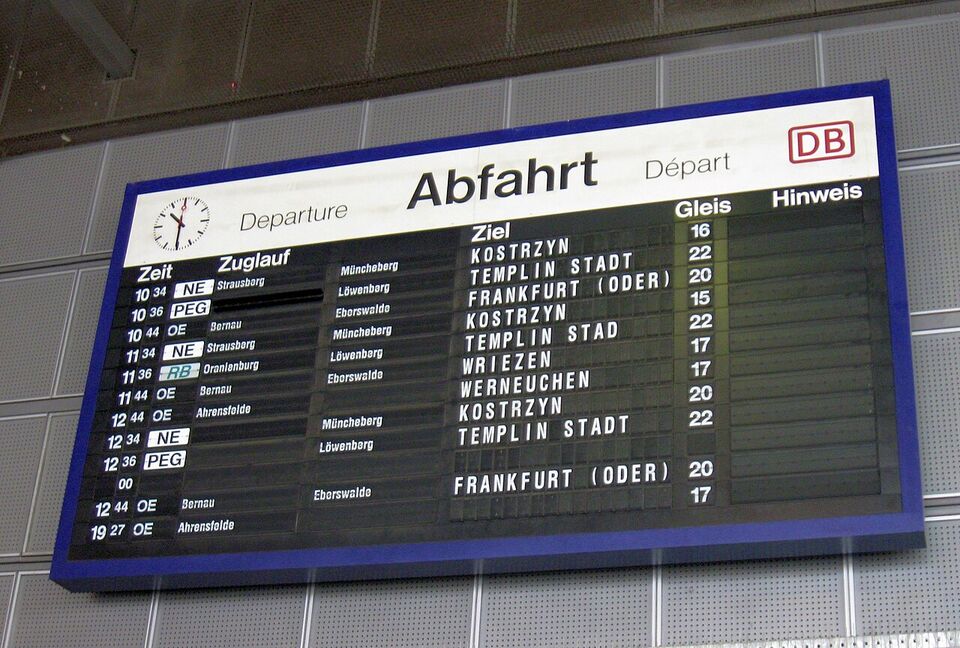
Train announcements in stations are in German, and on ICE trains often repeat in English. The board you need is the Abfahrt (departures) screen, which lists the platform (Gleis), the time, and the destination. A red number beside a time is a delay. If your train is canceled you will see Zugausfall or fällt aus. Ticket choices are covered in German train tickets and passes and general tips in Getting around Germany.
| English | German | Say it |
|---|---|---|
| Main station | Hauptbahnhof (Hbf) | HOWPT-bahn-hohf |
| Platform / track | Gleis | GLYSS |
| Departure | Abfahrt | AHP-fahrt |
| Arrival | Ankunft | AHN-koonft |
| Delay | Verspätung | fer-SHPAY-toong |
| Train canceled | Zugausfall | TSOOK-ows-fahl |
| To change trains | umsteigen | OOM-shty-gen |
| Replacement bus | Schienenersatzverkehr | SHEE-nen-er-zahts-fer-kayr |
| Ticket | Fahrkarte | FAR-kar-tuh |
| One way / round trip | Einfach / Hin und zurück | INE-fahkh / hin oont tsoo-REWK |
| Seat reservation | Sitzplatzreservierung | ZITS-plahts-ray-zer-VEE-roong |
| Where is platform 7? | Wo ist Gleis sieben? | voh ist glyss ZEE-ben |
| Does this train go to Munich? | Fährt dieser Zug nach München? | fairt DEE-zer TSOOK nakh MEWN-khen |
| Next stop | Nächster Halt | NAYKH-ster HAHLT |
| Ticket inspection | Fahrkartenkontrolle | FAR-kar-ten-kon-TROL-uh |
| Subway / commuter rail | U-Bahn / S-Bahn | OO-bahn / ESS-bahn |
Insider tip
In the DB Navigator app, a train marked "fällt aus" is canceled, and "Ersatzfahrt" or "Ersatzzug" means a replacement. When a platform changes, the display and an announcement say "Gleiswechsel." Check the screen again just before boarding.
Shopping and paying
Shops open and close on set hours, and most are closed on Sundays. Staff may not greet you unless you greet them first. A basic exchange, Guten Tag, a request, Danke, Tschüss, covers most visits. Cards are common in big shops but not universal, so it is worth asking before you fill a basket.
| English | German | Say it |
|---|---|---|
| How much is it? | Was kostet das? | vahs KOS-tet dahs |
| I'm just looking | Ich schaue nur | ikh SHOW-uh NOOR |
| Do you take credit cards? | Nehmen Sie Kreditkarten? | NAY-men zee kray-DEET-kar-ten |
| Cash only | Nur Barzahlung | noor BAR-tsah-loong |
| I'll pay by card | Ich zahle mit Karte | ikh TSAH-luh mit KAR-tuh |
| A bag, please | Eine Tüte, bitte | INE-uh TEW-tuh BIT-tuh |
| Do you have this in another size? | Haben Sie das in einer anderen Größe? | HAH-ben zee dahs in INE-er AHN-der-en GRUR-suh |
| Receipt | Quittung / Kassenbon | KVIT-oong / KAH-sen-bon |
| Tax-free form, please | Ein Tax-free-Formular, bitte | ine tacks-FREE for-moo-LAHR BIT-tuh |
| Deposit (bottles, mugs) | Pfand | PFAHNT |
| Open / closed | Geöffnet / geschlossen | guh-URF-net / guh-SHLOS-sen |
| Sale | Ausverkauf / Sale | OWS-fer-kowf / sayl |
Pfand is spoken with a "pf" sound that is hard for English speakers: put your lips together as if to say "p," then blow out an "f." Close enough is fine. Deposit rules and how the VAT refund works are explained in Money in Germany.
Directions and getting around town
German street names often end in -straße (street), -platz (square), -weg (path or lane) or -allee (avenue). A building number comes after the street name. Many people will give directions with "links," "rechts" and "geradeaus," and a map on your phone helps with the rest.
| English | German | Say it |
|---|---|---|
| Where is...? | Wo ist...? | VOH ist |
| the train station | der Bahnhof | dair BAHN-hohf |
| the bus stop | die Haltestelle | dee HAHL-tuh-shtel-uh |
| the toilet | die Toilette | dee toy-LET-uh |
| the airport | der Flughafen | dair FLOOK-hah-fen |
| the tourist information | die Touristeninformation | dee too-RIS-ten-in-for-ma-TSYOHN |
| left / right | links / rechts | LINKS / REKHTS |
| straight ahead | geradeaus | guh-RAH-duh-OWS |
| near / far | nah / weit | NAH / VITE |
| Is it far from here? | Ist es weit von hier? | ist ess VITE fon HEER |
| Can you show me on the map? | Können Sie es mir auf der Karte zeigen? | KURN-en zee ess meer owf dair KAR-tuh TSY-gen |
| I am lost | Ich habe mich verlaufen | ikh HAH-buh mikh fer-LOW-fen |
| Street / square | Straße / Platz | SHTRAH-suh / PLAHTS |
Emergencies and health
The European emergency number is 112 for fire and ambulance, and 110 is the police. Operators in big cities often speak English, but not always, so keep the key words ready. If you are not in danger but need medical help outside office hours, the number 116117 is the on-call doctor service. Details are in Health and medical care and Is Germany safe?.
| English | German | Say it |
|---|---|---|
| Help! | Hilfe! | HIL-fuh |
| Emergency | Notfall | NOHT-fahl |
| Call the police! | Rufen Sie die Polizei! | ROO-fen zee dee po-lee-TSY |
| Call an ambulance! | Rufen Sie einen Krankenwagen! | ROO-fen zee INE-en KRAHN-ken-vah-gen |
| Fire! | Feuer! | FOY-er |
| I need a doctor | Ich brauche einen Arzt | ikh BROW-khuh INE-en ARTST |
| I feel sick | Mir ist schlecht | meer ist SHLEKHT |
| It hurts here | Es tut hier weh | ess toot HEER VAY |
| Pharmacy | Apotheke | ah-po-TAY-kuh |
| Hospital | Krankenhaus | KRAHN-ken-hows |
| My wallet was stolen | Meine Brieftasche wurde gestohlen | MY-nuh BREEF-tah-shuh VOOR-duh guh-SHTOH-len |
| I lost my passport | Ich habe meinen Reisepass verloren | ikh HAH-buh MY-nen RY-zuh-pahs fer-LOH-ren |
| Thief! | Haltet den Dieb! | HAHL-tet dayn DEEP |
| I need an English speaker | Ich brauche jemanden, der Englisch spricht | ikh BROW-khuh YAY-mahn-den dair ENG-lish SHPRIKHT |
Numbers, prices and the clock
Germany writes prices with a decimal comma, so €3,50 means three euros fifty (€3.50, about $3.92). A period or space separates thousands: 1.250,00 € is the same as €1,250. This flips what Americans expect and is easy to misread on a menu, so look twice at the punctuation.
| English | German | Say it |
|---|---|---|
| 0 | null | NOOL |
| 1 | eins | INES |
| 2 | zwei | TSVY |
| 3 | drei | DRY |
| 4 | vier | FEER |
| 5 | fünf | FEWNF |
| 6 | sechs | ZEKS |
| 7 | sieben | ZEE-ben |
| 8 | acht | AHKHT |
| 9 | neun | NOYN |
| 10 | zehn | TSAYN |
| 12 | zwölf | TSVURLF |
| 20 | zwanzig | TSVAHN-tsikh |
| 21 | einundzwanzig | INE-oont-TSVAHN-tsikh |
| 50 | fünfzig | FEWNF-tsikh |
| 100 | hundert | HOON-dert |
| 1,000 | tausend | TOW-zent |
| €3.50 | drei Euro fünfzig | dry OY-roh FEWNF-tsikh |
| 8:30 | halb neun | hahlp NOYN |
| Quarter past three | Viertel nach drei | FEER-tel nahkh DRY |
Two things surprise visitors. First, numbers from 21 to 99 reverse: 21 is "one and twenty." Second, halb neun literally means "half nine" and is 8:30, not 9:30: the half hour is counted toward the next hour. Opening hours use the 24-hour clock, so 17:00 is 5 p.m.
Watch out
Do not read "halb sieben" as 7:30. It means 6:30. If a German friend proposes meeting at "halb acht," confirm "seven-thirty?" in English so you both mean the same hour.
Signs to recognize
Many frustrating moments for visitors come from signs. This list covers the ones that matter on the road, at a restaurant, in a shop and at a station.
| English | German | Say it |
|---|---|---|
| Exit (on foot) | Ausgang | OWS-gahng |
| Entrance | Eingang | INE-gahng |
| Exit (highway or driveway) | Ausfahrt | OWS-fahrt |
| One-way street | Einbahnstraße | INE-bahn-shtrah-suh |
| Detour | Umleitung | OOM-ly-toong |
| Roadwork | Baustelle | BOW-shtel-uh |
| Closed | Geschlossen | guh-SHLOS-sen |
| Weekly closing day | Ruhetag | ROO-uh-tahk |
| Holiday | Feiertag | FY-er-tahk |
| Company vacation | Betriebsferien | buh-TREEPS-fay-ree-en |
| Push / pull (door) | Drücken / Ziehen | DREW-ken / TSEE-en |
| Emergency exit | Notausgang | NOHT-ows-gahng |
| No smoking | Rauchen verboten | ROW-khen fer-BOH-ten |
| Caution | Achtung / Vorsicht | AHKH-toong / FOR-zikht |
| Out of order | Außer Betrieb | OW-ser buh-TREEP |
| Vacant / occupied | Frei / besetzt | FRY / buh-ZETST |
| Women / men (restroom) | Damen / Herren | DAH-men / HER-ren |
| Reserved | Reserviert | ray-zer-VEERT |
| Lost and found | Fundbüro | FOONT-bew-roh |
Save money
A restaurant with a sign that says "Ruhetag" or "Betriebsferien" is closed that day or weeks, even if its listing says open. Look at the weekly hours posted on the door before you cross town, and book a table if you are going on a Friday or Saturday evening.
Pronunciation: the sounds that matter
You do not need to be perfect. The following rules cover most of what you will read on signs and menus.
- w is pronounced like English v, so Wein sounds like "vine."
- v usually sounds like English f, so vier is "feer" and Verspätung starts with "fer."
- z sounds like "ts," so zwei is "tsvy."
- s before a vowel sounds like English z, so sieben is "ZEE-ben." The letter ß is a sharp "ss," as in Straße.
- sch is "sh." At the start of a word, st and sp are "sht" and "shp," as in Stadt and Speisekarte.
- ei sounds like "eye" and ie sounds like "ee." The pair eu or äu is "oy," and au is "ow."
- ü is "ee" said with rounded lips; ö is "ay" with rounded lips. Tschüss is close to "chewss."
- ch after a, o, u or au is a throaty hiss (like clearing your throat softly), and after other letters a softer hiss, like the "h" in "huge."
Every noun is capitalized in German, which makes signs look long and heavy. Take them one word at a time; the long compounds are just short words stuck together. Hauptbahnhof is "main train yard," meaning the main station. For help with local customs and what to say when, return to German etiquette.
Add it to a route in the trip builder, or ask us to plan the hotels, trains and guides for you.