Overview: trains first, cars second
For most first trips, the answer is the train. Germany's high-speed ICE network ties together Berlin, Hamburg, Frankfurt, Cologne, Stuttgart and Munich, the stations sit in city centers, and you skip the cost of rental cars, parking and fuel (see driving in Germany). A car makes more sense for villages, the Alps and a route like the Romantic Road, where trains and buses thin out.
This guide explains how the system works, what the different trains are, how to read a departure board and find your coach, what to do when a train is late, and how city transit, buses, flights and taxis fit in. For which ticket to buy, including the Deutschlandticket, saver fares and passes, go to German train tickets and passes. For the full planning picture, start at planning your trip.
One honest warning: Germany's rail network is busy, old in places and under heavy repair. Deutsche Bahn (DB) says its long-distance trains were on time (arriving less than 6 minutes late, by DB's usual method) roughly 52% to 64% of the time in each month of 2026 through October. That is not a reason to avoid trains. It is a reason to book flexible connections, avoid the last train of the day for anything important, and read the section on delays below before you go.
Train types: ICE, IC, RE, RB and S-Bahn
German trains are named by category, and the category tells you the speed, the stops and the ticket you need.
| Name | What it is | Where you use it |
|---|---|---|
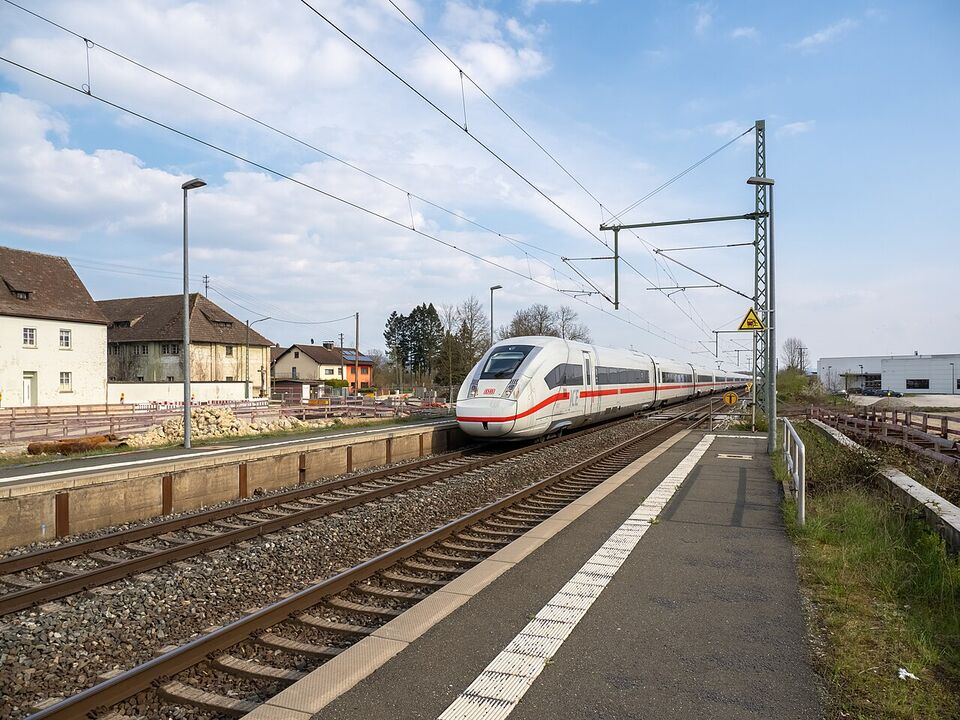
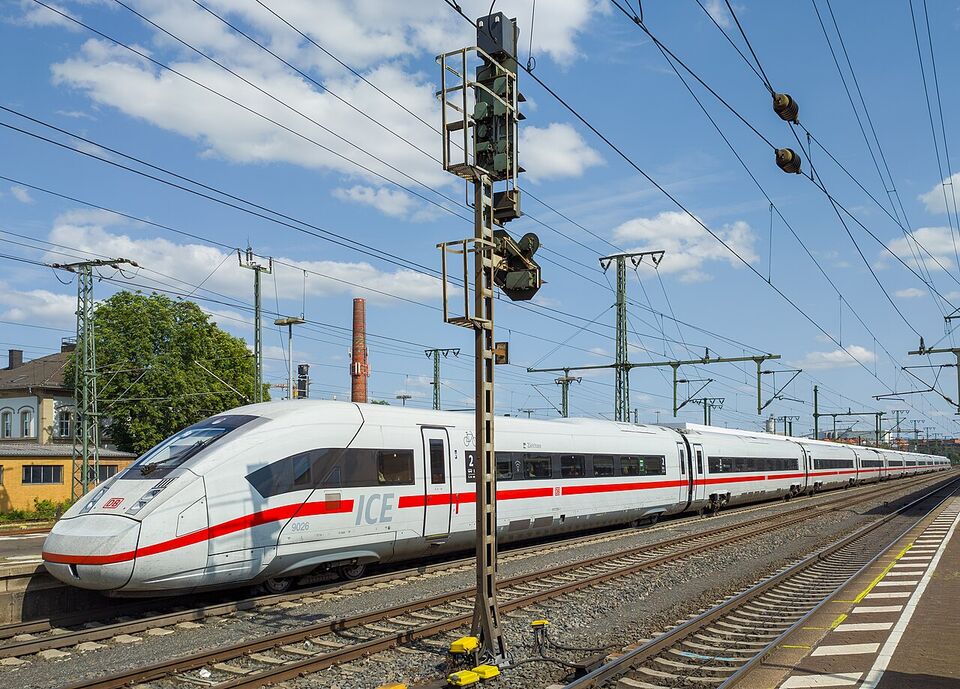
| ICE (InterCity Express) | Fast long-distance train, white with a red stripe. Few stops, reservations available, onboard bistro on many | Berlin, Hamburg, Frankfurt, Cologne, Stuttgart, Munich and other main cities |
| IC and EC (InterCity, EuroCity) | Slower long-distance trains, often older coaches. EC crosses borders | Secondary routes such as Hamburg to Dresden or trips toward Salzburg and Zurich |
| IRE and RE (Regional-Express) | Regional train with limited stops | City to nearby city, such as Munich to Füssen or Munich to Nuremberg |
| RB (Regionalbahn) | Slow regional train that stops almost everywhere | Small towns and branch lines |
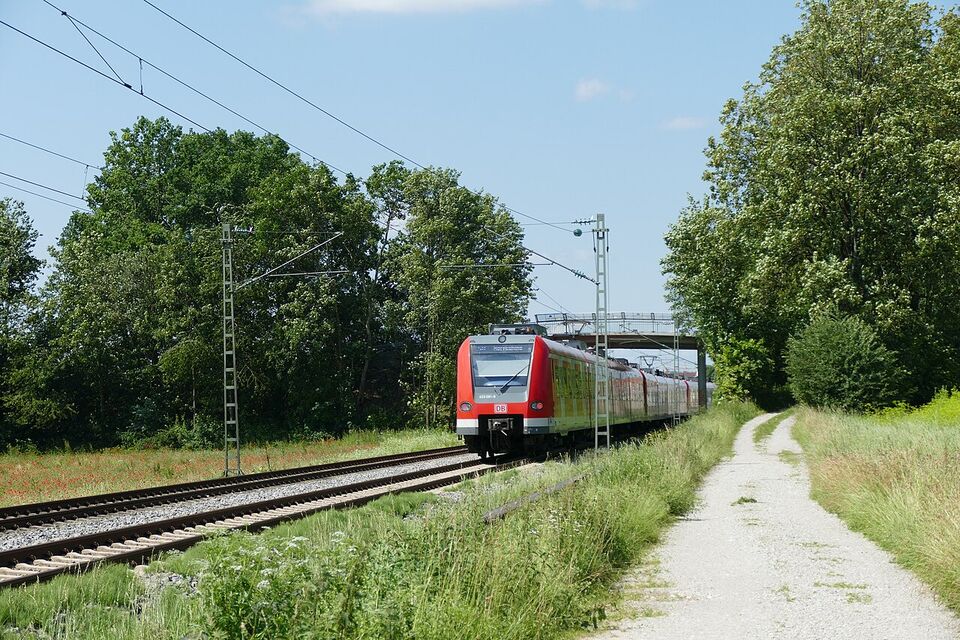
| S-Bahn | Suburban rail with tight timetables, often every 10 to 20 minutes | Airports, suburbs, and short trips to places like Potsdam |
| U-Bahn, tram, bus | City transit | Inside cities |
The practical rule: ICE and IC/EC trains need a long-distance ticket; RE, RB and S-Bahn trains accept regional tickets, Länder tickets and the Deutschlandticket (described on the tickets page). The Deutschlandticket does not cover ICE, IC or EC trains. If you board an ICE with a regional-only ticket you can be fined, so check the train name on the board before you step on.
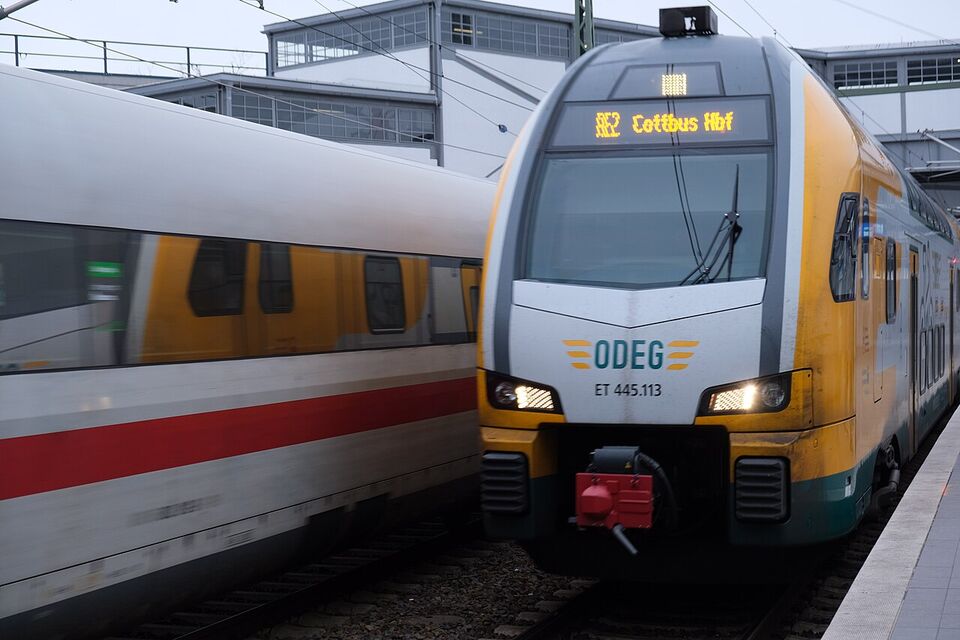
Many private operators also run regional lines under contract, and their trains accept the same regional tickets. They show up in DB Navigator alongside DB's own trains.
DB Navigator and how to plan
DB Navigator is the official app from Deutsche Bahn for iPhone and Android, and it is the single most useful tool you will install. It shows live departures, platform changes and delays, sells tickets (long-distance and many regional ones) and stores them as a QR code you show to the conductor. The bahn.de website does the same. Download it and set up an account before you leave home so you are not wrestling with a payment screen on a platform.
Search by station name, not by city, when a city has several stations (Berlin Hauptbahnhof is not Berlin Ostbahnhof). Use the German name the app shows. Set the date and time of departure, and use the "Connection details" screen to see platforms, train numbers and your connection time.
A few habits help:
- Choose "Fast connections" or add a longer minimum transfer time when the route is important. A 4-minute change in a large station is a gamble.
- Screenshot your ticket QR code. Train cellular signal drops in tunnels and rural stretches.
- Turn on push notifications for your trip. The app warns about platform changes and cancellations before the board does.
- Look at the train's name and number. If a delay announcement says "ICE 693", the number is what you search for on the board.
Tickets for long-distance trains can be bought in the app, on bahn.de, at the yellow-and-red ticket machines in stations, or at a staffed DB Reisezentrum (travel center). Machines accept cards but are sometimes finicky with US cards; the app usually works fine. For big journeys, reading about the fare types first on the tickets page will save you money.
Reading the departure board and finding your coach
German stations use two kinds of boards. Yellow boards (Abfahrt) list departures; white or other-colored boards (Ankunft) list arrivals. A departure line shows the time, the train name and number (such as ICE 1005), the destination, the main stops, and the platform, which Germans call Gleis (track). The same number is the platform number on the signs overhead.
Words you will see next to a train:
- +10 or a red time: the new, delayed departure time.
- Fällt aus: cancelled. Check the app for the next option immediately.
- Gleiswechsel: the platform changed. Move quickly.
- Heute ohne Halt in ...: today this train skips a stop.
- Zug fährt in umgekehrter Wagenreihung: the coach order is reversed. Check the coach layout again before you walk.
The Wagenstandsanzeiger
The Wagenstandsanzeiger (coach position display) is a panel on the platform that shows where each coach will stop. Platforms are divided into sectors marked with letters, usually A to G, along the platform. The display shows the train type, the destination and a diagram: first-class coaches, the dining car, and where your coach number sits relative to sectors.
This matters because an ICE can be 12 coaches and about 360 meters (1,180 ft) long. If your seat is in coach 11 and you stand at sector A, you are a long walk from it. DB Navigator shows the same coach order (Wagenreihung) for your train, so you can plan before it arrives. Your ticket or reservation lists the coach number, the seat number and the sector if known.
Insider tip
Check the coach order while you wait, not when the train rolls in. ICEs may stop for under two minutes, and German trains often leave on the minute. Stand by the sector letter for your coach so you step on at the right door.
Seat reservations
You do not need a reservation to ride a long-distance train with a flexible ticket, and unreserved seats are free. But many ICEs fill on Friday afternoons, Sunday evenings, holiday weekends and Christmas-market weekends (see Christmas markets). Standing in the vestibule for three hours with luggage is no fun.
A seat reservation costs about €5.50 (about $6) per one-way trip in 2nd class and about €6.90 (about $8) in 1st class, according to a third-party site, since we could not load DB's own fee page (a 1st-class Flexpreis ticket includes the reservation). Check the price when you book. Book it at the same time as your ticket in the app. The fee applies per person and per trip, and it does not change with the length of the trip, so it is the best deal on long runs and worth skipping on short hops.
Saver fares (Sparpreis) are tied to a specific train but do not automatically include a seat. The reservation is a separate choice you add. Look for the small seat icon on the train: reserved seats show a display above the seat saying which stretch of the journey it is reserved for. If a seat shows no reservation, you can take it.
On a family trip, reserving seats together is the main reason to pay the fee. Reserve one extra seat for a stroller or large luggage only if the train has space; ask the staff or check the coach layout.
Delays, cancellations and your rights
Because delays are common, the rules are worth knowing. The key idea: your ticket is a contract, and the EU gives you rights when trains are late.
Money back for delays
Under EU passenger-rights rules (Regulation 2021/782, which DB applies), if you arrive at your final destination 60 to 119 minutes late you can claim 25% of the ticket price for that journey. If you arrive 120 minutes or more late, you can claim 50%. Payments under €4 are generally not made. To claim, use the Fahrgastrechte (passenger rights) form on bahn.de or in the DB Navigator app, or fill in the paper form at a DB travel center. You usually need your ticket and the date and train number. There is a deadline of one year to claim, but do it the same week while the details are fresh.
If you travel on a pass or a Deutschlandticket, the compensation rules differ, so check the current terms on bahn.de.
Zugbindung aufgehoben
Saver tickets are normally bound to a specific train (Zugbindung). But if your train is delayed by 20 minutes or more, or cancelled, the binding is normally lifted (DB's usual rule; confirm in the app): the app and the conductor will say Zugbindung aufgehoben. From that moment your ticket is valid on any train toward your destination, including ICE trains, on the same day. Keep the screenshot of the delay message if you can.
If you miss a connection because of a delay on a ticket booked as one journey, you are covered: board the next suitable train and tell the conductor. If you booked two separate tickets, the second one is your problem, so allow a bigger buffer or book through-tickets.
If a delay would put you at your destination after midnight, you may be able to claim a taxi or a hotel. In some cases DB reimburses a taxi up to about €80, but we could not confirm the current terms, so ask at the service point. Ask at the service point and keep receipts.
Different from home
In the US, Amtrak delays rarely trigger money back. In Germany it is a legal right and the claim is a form, not a favor. Americans often skip it because the amount looks small. File it, especially on a €100 fare.
Construction closures in 2026 and 2027
Deutsche Bahn is rebuilding its busiest corridors one at a time, closing a line completely for months and sending trains around it. This is called a Generalsanierung (general renovation). It changes travel times, so check any long trip in DB Navigator close to departure.
- Hannover to Berlin: the section between Fallersleben and Berlin-Spandau is closed from October 2 to December 12, 2026. From December 13, 2026 to October 15, 2027 the line from Oebisfelde to Wustermark is closed. Long-distance trains run via Braunschweig and Magdeburg. A trip between Cologne or Düsseldorf and Berlin takes about 5.5 hours, roughly 80 minutes longer than usual.
- Frankfurt to Berlin: hourly ICE in about 4.5 hours. Work between Frankfurt and Erfurt is expected to cancel the Sprinter (fast) trains for several months in 2027 (early February to mid-May, and again from mid-August).
- Hamburg to Berlin: the line reopened in 2026. From December 13, 2026, trains return to a half-hour interval. In 2027, work near Berlin-Spandau should add 35 to 45 minutes.
- Right bank of the Rhine (Troisdorf to Wiesbaden): closed July 10 to December 12, 2026. If you plan Rhine-side rail views, see Rhine and Moselle and check the left-bank line.
- Obertraubling to Passau (Regensburg to Passau): closed June 14 to December 12, 2026.
- Lehrte to Fallersleben: closed February 5 to July 9, 2027. Rosenheim to Salzburg: closed February 7 to July 9, 2027 (EC trains run via Mühldorf, three a day). Bremen to Bremerhaven: July 9 to December 11, 2027. Fulda to Hanau: August 13, 2027 to February 4, 2028.
Good news: new fast Sprinter trains start December 13, 2026, with three pairs a day between Berlin and Stuttgart (4 hours 45 minutes) and between Hamburg and Munich (5 hours 20 minutes, 20 minutes faster). Stuttgart's new through station, Stuttgart 21, will not open in December 2026 as planned; Deutsche Bahn now gives December 2031, so the current station remains your arrival point.
Watch out
Schedules and closure dates move. The dates above come from Deutsche Bahn's published construction table and press reports as of November 2026. Re-check your exact date in DB Navigator or on bahn.de the week you travel.
Travel times between major cities
The table shows typical fastest ICE times in 2026. Real times depend on the day, construction and delays, so treat them as planning numbers and confirm in DB Navigator.
| Route | Typical time | Notes |
|---|---|---|
| Berlin to Munich | About 4 to 4.5 hr | Via Halle/Leipzig and Nuremberg, hourly |
| Berlin to Hamburg | About 1 hr 45 min | Longer in 2027 during work near Spandau |
| Berlin to Frankfurt | About 4 hr 30 min | Hourly ICE |
| Berlin to Cologne | About 5 hr 30 min | Detour via Magdeburg until late 2027 |
| Berlin to Stuttgart | About 4 hr 45 min | New Sprinter from December 13, 2026; otherwise via Frankfurt |
| Frankfurt to Munich | About 3 hr 15 min | Direct ICE |
| Frankfurt to Cologne | About 1 hr 10 min | High-speed line |
| Hamburg to Munich | About 5 hr 20 min on Sprinter | Slower on other trains |
| Munich to Nuremberg | About 1 hr 5 min | ICE |
| Munich to Füssen | About 2 hr | Regional train (for Neuschwanstein) |
Only the Berlin-Cologne, Berlin-Frankfurt, Berlin-Hamburg, Berlin-Stuttgart and Hamburg-Munich times above come from Deutsche Bahn announcements and press reports; the others are typical timetable values that we could not re-verify on bahn.de for the December 2026 timetable. Always run the live search.
City transit and validating tickets
Every German city has an integrated system: U-Bahn (subway), S-Bahn, trams and buses on one fare. Tickets are sold in zones. Buy at a machine, in the operator's app or, in some cities, from the bus driver. Prices rose on January 1, 2026 in most places.
| City | Single ticket | Day ticket | Notes |
|---|---|---|---|
| Berlin (zones AB) | €4.00 (about $4.50) | €11.20 (about $13) | Short trip €2.80 (about $3); 4-trip card €12.40 (about $14); airport needs ABC at €5.00 (about $6) |
| Munich (zone M) | €4.20 (about $5) | €10.10 (about $11) | Group day ticket zones M-5 €32.60 (about $37); 2027 day ticket zone M €10.80 (about $12) |
| Frankfurt (city) | €3.80 (about $4) | €7.75 (about $9) | The airport is a separate fare area; check the price at the machine |
| Hamburg | €12.60 for the full six-ring area (about $14) | €8.20 (about $9) | Cheaper short-ring tickets exist; online purchase gets about 7% off |
The big difference from home is that in most cities there are no turnstiles. Instead there is an honor system backed by inspectors in plain clothes. If you ride without a valid ticket you pay a fine, commonly €60 (about $67). "I'm a tourist" does not work as a defense.
Validation depends on the ticket. Tickets bought in an app are valid right away. Single tickets from most station machines are already stamped. But strip tickets, multi-trip cards and some paper tickets must be stamped in a small machine (an Entwerter) at the platform entrance or inside the bus or tram before your first ride. If in doubt, look at the ticket for a printed time; if it has none, stamp it. Long-distance DB tickets do not need stamping.
Airport links
- Berlin BER: the FEX express from Berlin Hauptbahnhof takes about 23 minutes and runs up to four times an hour. The S9 takes about 40 minutes from Alexanderplatz.
- Munich: S1 and S8 trains reach the city center in about 35 minutes.
- Frankfurt: the S-Bahn takes about 12 minutes to the Hauptbahnhof, and the long-distance station at the airport has ICE connections.
For city specifics see Berlin and Munich, and for how to arrive see flights to Germany.
Buses: FlixBus and FlixTrain
FlixBus (green buses) is the main long-distance bus brand and covers nearly every city at low fares, with frequent departures from the central bus station (ZOB) or a stop near the Hauptbahnhof. FlixTrain, from the same company, runs some long-distance trains on a few routes. The advantage is price: on some routes, a bus ticket can be a fraction of a train fare. The cost is time (Berlin to Munich takes roughly seven hours or more) and traffic risk.
Bus fares float with demand, so we do not quote a price. Buses suit a short hop with no good train, or a budget run between cities, but for most city pairs a saver train fare booked early is close in price and far faster. FlixBus tickets are not interchangeable with DB tickets or the Deutschlandticket.
If you ride a bus, arrive 15 minutes early, check the stop name (Flix uses a lot of stops outside stations), and keep a screenshot of the ticket.
Domestic flights
Germany's main hubs, Frankfurt and Munich, link to Berlin, Hamburg, Düsseldorf and other cities, but most flights between German cities are a poor deal compared to trains. By the time you get to the airport, clear security and travel into the city, you rarely beat a 4-hour ICE. A flight can still make sense from Munich to Hamburg or Berlin if you find a cheap fare and have no luggage issues, or if you are connecting from a transatlantic flight (your arriving bags are checked through).
If you are flying in and out of different airports, see flights for open-jaw ideas. Rail and fly combinations exist: DB sells tickets to Frankfurt Airport's long-distance station, and from there you can travel to many cities without going into Frankfurt. Check each airline's rules on baggage on separate tickets.
Taxis, Uber and ride apps
Licensed taxis are cream-colored in many cities (and black or other colors in some). You hail at stands or call a taxi app. Fares are metered and set by the city, with a base fee, a per-kilometer rate and extra for luggage and night in some cities. Pay by card or cash; ask before you start whether the driver accepts your card, since some do not. Tip by rounding up (see money).
Uber works in Berlin, Munich, Hamburg, Frankfurt and some other cities, but it mainly dispatches licensed taxis and rental cars with drivers. It is not the same as in the US. FREE NOW is a taxi-booking app popular in German cities and shows the metered fare estimate. Bolt operates in several cities. Availability varies, so install the app before you arrive and compare with the taxi stand.
Short taxi rides cost more than transit, so use them late at night, with heavy luggage or in bad weather. A typical airport taxi into a city center costs far more than the train, and we could not confirm current airport fares.
Luggage on trains and in stations
There is no check-in and no weight limit for luggage on German trains, which is the biggest advantage over flying. The rule is you must be able to carry and lift your own bags. ICE coaches have luggage racks at the ends of coaches and overhead shelves; large suitcases go on the end racks or between seat backs, and seats near the doors fill first. Keep valuables with you, as bag theft happens in stations and on trains (see safety).
Big stations have coin or card lockers (Schließfächer) in several sizes, useful on a day in a city when you arrive early or leave late. Prices vary, but expect a few euros for a small locker and more for large ones. Some stations offer staffed luggage storage; check the station page on bahn.de.
Elevators and escalators exist at major stations but not every small stop. If you have lots of luggage, plan for stairs, and travel light for the regional-train legs. Bicycles are allowed on many regional trains and some long-distance trains with a bike ticket and reservation, but that is a topic for cyclists to check on bahn.de.
Save money
Avoid the temptation to buy a taxi or a flight for a short hop. A regional ticket or a Deutschlandticket (€63, about $71, for a calendar month in 2026; €66.80, about $75, from January 1, 2027) often covers a whole region. Compare it with single tickets on the tickets page before you spend.
When a rental car is better
Choose a car when you want to visit small villages, castles, vineyards or the Alps, when you travel as a family of four or more (a car can be cheaper than four tickets), or when your route follows scenic roads. A car also helps for a base in the countryside, when you will return to your lodging each night. See driving in Germany for licenses, rules and fuel costs, and where to stay to pick a place with parking.
Many travelers do both: take trains between big cities and rent a car for a few days in a region such as Bavaria or the Moselle. Pick up the car at the edge of town, not in the center, and drop it before you return to the city.
Add it to a route in the trip builder, or ask us to plan the hotels, trains and guides for you.