Overview: the old heart of Germany
Central Germany is the part of the country that history lovers tend to enjoy most and Americans skip most. It stretches across the states of Thuringia and Saxony-Anhalt, between Berlin, Frankfurt and Munich, and it holds some of the most important places in German cultural life: Weimar, where Goethe and Schiller lived and the Bauhaus school began; Erfurt, a medieval city with an intact old town; the Wartburg, where Martin Luther translated the Bible; and the Harz mountains, with half-timbered towns and a steam railway to the Brocken summit.
It is also the place where Germany's darkest history sits close to its brightest. The Buchenwald concentration camp memorial is on the hill above Weimar, and a visit there is part of understanding the city. We cover that site below, and in History sites in Germany.
A good plan is four to five days. Start in Weimar and Erfurt, spend a day on the Wartburg and Eisenach, and finish in the Harz. If you are coming from Dresden, see Dresden and Saxony; from Berlin, our Berlin guide covers the rest of the route. The wider picture is in Germany's destinations.
Getting here and getting around by train
The region has good rail links, with one catch: the Harz is off the high-speed network, so you will use slower regional trains there. The main routes:
- Berlin to Erfurt and Weimar: about 2 hours to Erfurt by fast train, then a short regional hop to Weimar.
- Frankfurt or Munich to Erfurt: roughly 2 hours from Frankfurt and about 3 hours from Munich on the fast line. Weimar is a short ride east of Erfurt.
- Leipzig to Weimar: under an hour or so by regional or fast train.
- Erfurt to Eisenach: roughly 25 to 40 minutes, depending on the train.
- To the Harz: regional trains to Wernigerode and Quedlinburg, usually with a change. From Berlin or Hannover, allow most of a morning.
We have not checked exact times for every route, so plug your dates into bahn.de or the DB Navigator app. Two construction notes: the Hannover-Berlin high-speed line closes in December 2026 for about a year, which adds time to trains between Berlin and the west, and Deutsche Bahn lists Hanau-Fulda (on the Frankfurt side) among its major rebuilds in 2027, so check Frankfurt connections too. If your route crosses either corridor, check it close to departure. For fares and reservations, see German train tickets and passes and Getting around Germany.
Different from home
Regional trains in Germany are cheap and frequent compared with Amtrak, but a regional day pass or the Deutschlandticket (€63 a month in 2026, about $71) covers only regional services, not the fast ICE trains. The narrow-gauge Harz railways are run by a separate company, so do not assume a rail pass or Deutschlandticket works on them; check first.
Weimar
Weimar is a small city of roughly 65,000 people that carries an outsize place in German history. Goethe lived here for about fifty years, and Schiller lived here too, so the city became the center of what Germans call "Weimar Classicism" around 1800. In 1919 the German national assembly met here to write the constitution of the republic that took the city's name, and in the same year Walter Gropius founded the Bauhaus school here. UNESCO has listed both the Classical Weimar sites and the Bauhaus sites as World Heritage.
The old center is compact, and you can see it on foot in a day. Start on the Markt, then walk to Goethe's house on the Frauenplan, Schiller's house a few minutes away, and the Park an der Ilm, a landscape park along the river with Goethe's garden house. Most of the city's museums are run by one foundation, the Klassik Stiftung Weimar, and you can buy tickets and passes on its site at klassik-stiftung.de.
Goethe and Schiller
The Goethe National Museum combines the house where Goethe lived from the 1780s to his death in 1832 with a large exhibition. The Schiller Museum is in the house where Friedrich Schiller lived in his last years. We could not read the foundation's current price list. A third-party listing shows an adult ticket for Goethe's house at about €14 (about $16), with winter hours of roughly 9:30 a.m. to 4 p.m. and Mondays closed, but confirm both on the official site before you go. Hours are shorter in winter, and some rooms may be closed for conservation.
The Bauhaus Museum
The Bauhaus Museum Weimar opened in 2019 for the school's 100th anniversary. It shows the early years of the Bauhaus, including workshop pieces, furniture, textiles and ceramics from the collection that began in Weimar. It is a good stop if you like design, and it takes 1 to 1.5 hours. It is a short walk from the Goethe sites. Check opening days and prices on the foundation's site. For more on museums and design across the country, see Germany by interest.
The Anna Amalia Library
The Duchess Anna Amalia Library holds the Rococo Hall, an oval room lined with books that looks like a painting. A fire in September 2004 destroyed about 50,000 volumes, and the hall reopened in 2007 after restoration. Visitor numbers in the hall are limited, and entry is by timed ticket, so book online through the foundation if the library is on your list. The Rococo Hall is small, so plan about 30 minutes, and note that large bags and coats usually go in a locker.
Insider tip
If you want to see both the Goethe sites and the Rococo Hall in one day, check ahead for the Weimar Card or a combined pass on the foundation's site, and book the timed Rococo Hall slot first. The hall is the one thing that can sell out; the museums rarely do.
Buchenwald memorial
Buchenwald was one of the largest concentration camps on German soil. The SS ran it from July 1937 until April 1945, and about 280,000 people were imprisoned there and in its subcamps. More than 56,000 died. US forces reached the camp on April 11, 1945. After the war the Soviets used the site for a special camp until 1950, and the memorial today covers both periods.
The memorial is about 6 miles (10 km) from central Weimar. It is free to enter, and from Weimar's main station you take city bus line 6. We could not confirm the current bus timetable, so check it on the day or ask at the station. Exhibitions are open Tuesday to Sunday and on public holidays, 10 a.m. to 4 p.m. from November to March (10 a.m. to 6 p.m. April to October). They are closed on Mondays, though the outdoor historic grounds can be visited daily until dusk. On November 9, 2026 the former cells in the gatehouse can be visited only until 11:30 a.m., and some paths are restricted.
Allow 3 to 4 hours. Public guided tours last about two hours. The memorial also offers a free "Buchenwald" app that works as a self-guided audio tour. Dress warmly, since the site is on an exposed hill, and expect a long walk. Wear sensible shoes. The grounds are large and the museum is in the former storage building. For advice on behaving at memorials, see our German etiquette guide, and for similar sites near Munich and Berlin, Munich sights and Day trips from Berlin.
Watch out
Do not combine Buchenwald and a long sightseeing day in Weimar if you can avoid it. Most visitors find the memorial emotionally heavy, and rushing it to catch a museum slot is a poor trade. Go in the morning, take your time, and keep the afternoon free.
Erfurt
Erfurt is the capital of Thuringia and has one of the best-preserved medieval city centers in Germany, because it was not heavily bombed. It is about 15 to 20 minutes by train from Weimar, so it works as a day trip, or as a base for the whole region because of its rail connections.
Cathedral and St. Severus
The cathedral and the church of St. Severus stand side by side above a large square, reached by a wide flight of steps. They are among the most striking sights in the city. Check visiting hours on the day, since services limit access.
Krämerbrücke
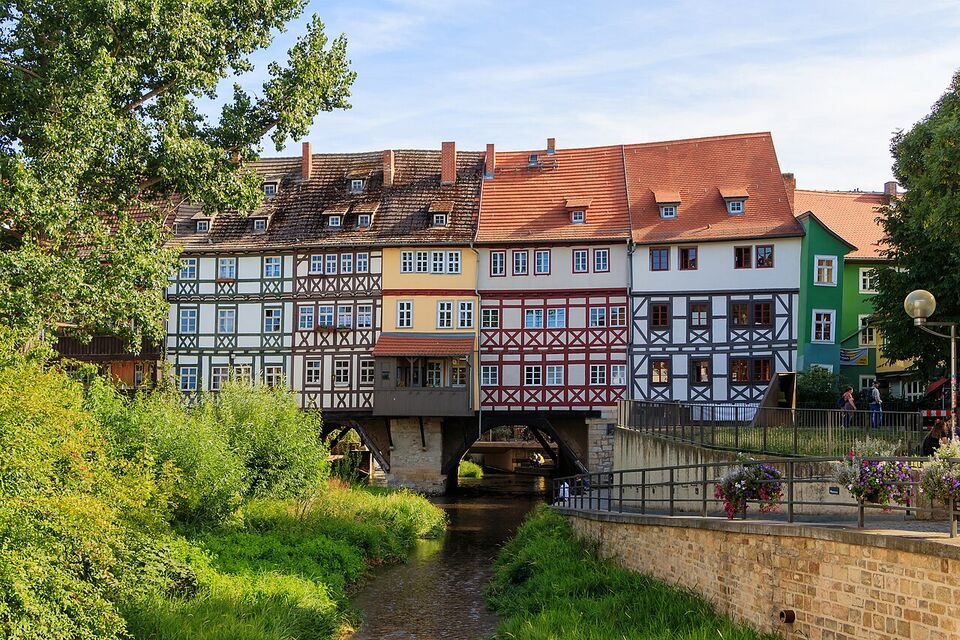
The Merchants' Bridge is lined with half-timbered houses that hold small shops and workshops, and it is billed as the longest series of inhabited buildings on a bridge in Europe. Walk across slowly, then look back from the river.
Old Synagogue
One of the oldest and best-preserved medieval synagogues in Europe, listed by UNESCO in September 2023 with the medieval mikveh and the Stone House. Check the museum's hours and ticket details.
Petersberg Citadel
A large baroque fortress above the town center, with guided tours and views. It is a good rainy-day stop if you want to walk the underground passages.
Martin Luther studied at the university in Erfurt and entered the Augustinian monastery here in 1505. If you are following Luther's trail, Erfurt and the Wartburg both belong on the same route. The city's Christmas market usually runs from late November to just before Christmas; confirm the 2026 dates on the city tourism site, erfurt-tourismus.de. For markets across the country, see Christmas markets in Germany.
Eisenach and the Wartburg
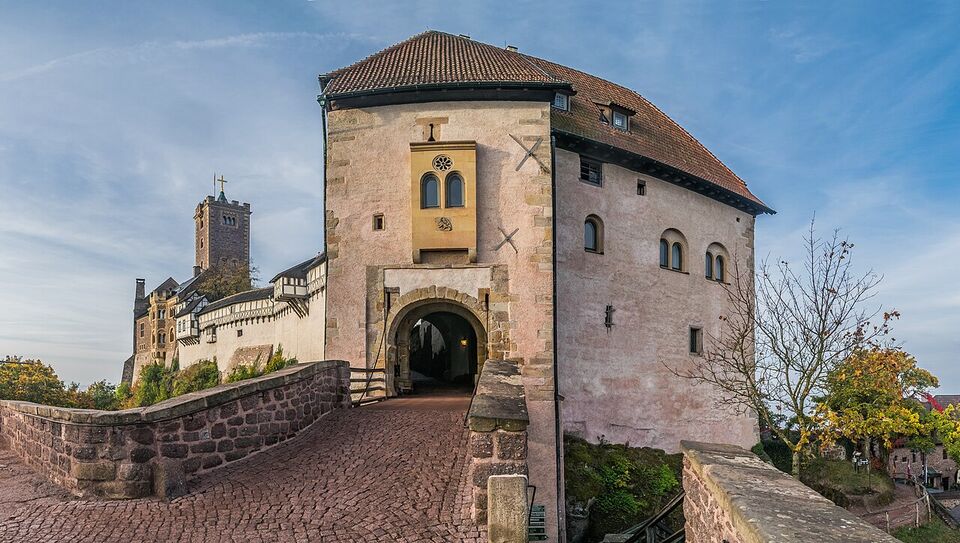
The Wartburg is a medieval castle on a hill above the town of Eisenach, and it is a UNESCO World Heritage site. Its founding goes back to about 1067. Saint Elisabeth of Hungary lived here in the early 1200s. Martin Luther was hidden in the castle in 1521-22, under the name "Junker Jörg," and in about ten weeks he translated the New Testament from Greek into German. The small room where he worked, the Lutherstube, is the best-known spot. In 1817 about 500 students met here for the Wartburg Festival, an early call for German unity.
Tickets and hours
The Wartburg is open every day of the year. From November 2, 2026 to March 25, 2027 the ticket desk is open from 10 a.m. to 3 p.m. and the outdoor areas close at 4:30 p.m., so arrive by early afternoon. On December 24 the castle is open 10 a.m. to noon, with tours at 10 a.m. and 11 a.m.
| Ticket (2026) | Price | Notes |
|---|---|---|
| Adult | €13 (about $15) | Interior rooms; courtyards and outdoor areas are free |
| Reduced | €9 (about $10) | Students, trainees, people with disabilities, others with proof |
| Students 7-18 | €5 (about $6) | Children up to 6 are free |
| Family | €31 (about $35) | 2 adults and up to 5 children; one-adult version €22 (about $25) |
| Castle shuttle | €4 one way (about $4), €7 round trip (about $8) | From the parking area at the foot of the hill |
The castle sells day tickets at the box office, and advance tickets online through the Wartburg website. Both guided tours and a self-guided route with an audio guide are offered, but we could not confirm English tour times, so check before you go. The site also says the castle stays open during construction planned for 2027, with some restrictions.
Eisenach is also the birthplace of Johann Sebastian Bach, and there is a Bach house museum in town. The walk up from the town takes roughly 30 to 45 minutes on a steep path; most people take a local bus to the foot of the hill or the shuttle for the last stretch.
The Harz mountains
The Harz is a low mountain range in the north of this region, partly in Saxony-Anhalt and partly in Lower Saxony. It is a landscape of forests, small towns with half-timbered houses and old mining sites. It is popular with Germans for hiking in summer and winter sports in a good snow year, and much less known to Americans, which makes it quieter than the Rhine or the Romantic Road.
Wernigerode
Wernigerode is the best base for the Harz. Its old town has colorful half-timbered houses around the town hall, and a hilltop castle overlooks it. It is also where the steam trains to the Brocken leave from, and it has hotels in most price ranges. A day or two here is enough.
The Brocken steam railway
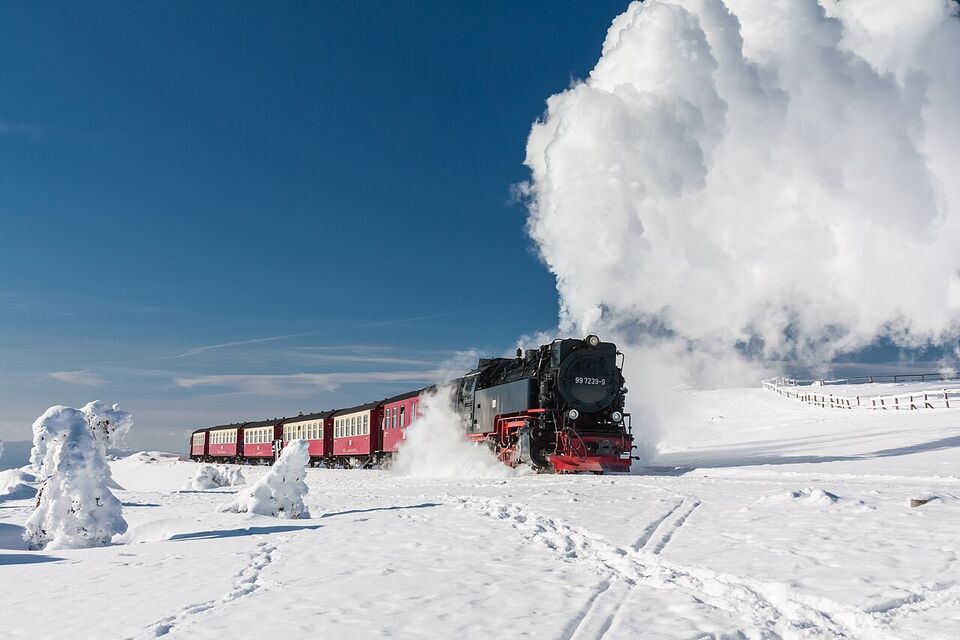
The Brocken is the highest peak in the Harz and in northern Germany, at 3,743 ft (1,141 m). The summit is above the tree line, and it is foggy and windy for much of the year, with a mean annual temperature of about 37°F (3°C). The narrow-gauge Brocken Railway, which opened in 1899, still runs with steam locomotives, with a station at 3,691 ft (1,125 m), the highest in Germany. The steepest part of the climb starts at Drei Annen Hohne and takes about 50 minutes.
| Brocken railway fare (2026) | Adult | Child 6-14 |
|---|---|---|
| One way | €43 (about $48) | €26 (about $29) |
| Round trip | €65 (about $73) | €39 (about $44) |
| Afternoon round trip | €55 (about $62) | Check operator |
The same fare applies from any station on the line. The cheaper afternoon fare applies on selected trains: from Wernigerode these leave at 2:54 p.m. and 4:32 p.m., and from Drei Annen Hohne at 4 p.m. and 5:31 p.m. The operator publishes a November 2026 timetable and a 2026/27 winter timetable, and the afternoon departures above come from its autumn timetable, so confirm times and the dates of the switch on the Harzer Schmalspurbahnen site, and check whether a steam locomotive or a diesel is scheduled for your train, since it varies. Winter weather can delay or limit services.
Save money
If you do not need the summit view, you can reach the Harz villages by regular regional train and walk. The afternoon fare saves €10 (about $11) on the round trip, but it leaves less daylight at the top in winter, so it works better from spring to autumn. Fog often hides the summit view, so do not pay for a day ticket on a day with a poor forecast.
Quedlinburg
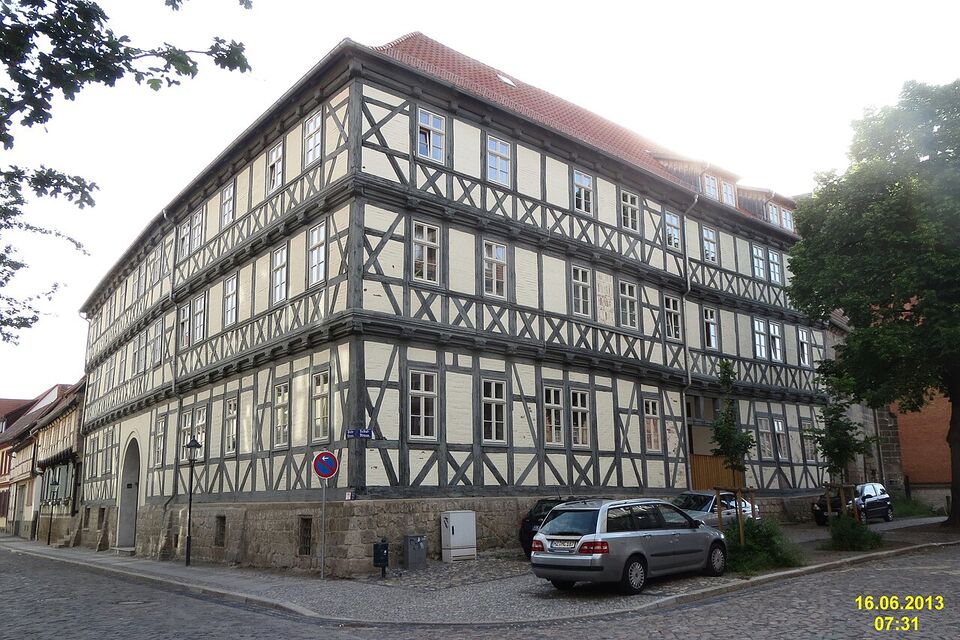
Quedlinburg is a UNESCO World Heritage town (listed in 1994) with roughly 2,000 half-timbered houses, some dating back centuries, and a castle hill with the Romanesque Collegiate Church of St. Servatius. The church treasury was stolen in 1945 by an American soldier and returned in 1993, a story worth knowing before you go. The town is a compact day or an overnight, and it is a good place to eat and stroll. Many Harz towns hold small Advent markets in courtyards and squares, but dates vary, so check the town's tourism office for 2026.
Goslar
Goslar is on the northern edge of the Harz, in Lower Saxony, about 25 miles (40 km) from Wernigerode. Its old town, with more than 1,500 timber-framed houses, and the nearby Rammelsberg mine are both UNESCO World Heritage sites. The Kaiserpfalz, an imperial palace restored in the 1800s, stands above the old town. Goslar is easy from Hannover by regional train, so it fits well if you are arriving from the north or west.
Where to stay
Pick a base by what you want to do, then take day trips by train. Weimar is the best base for Goethe, the Bauhaus and Buchenwald, and it has a good range of small hotels and guesthouses. Erfurt has the best train connections and is a practical base for Weimar, Eisenach and Leipzig. Eisenach is only needed if you want an early start at the Wartburg. In the Harz, Wernigerode and Quedlinburg are the best bases; Wernigerode has the steam railway, and Quedlinburg is quieter and more atmospheric in the evenings.
Use these tiers: $ is under $120 a night for a double, $$ is $120 to $300, and $$$ is over $300. Most hotels in this region fall in $ or $$, and the high end is rare. Several towns add a small overnight tax; Weimar's is a small per-room charge. See Where to stay in Germany for how city taxes and breakfast work.
A five-day plan
- Day 1
Weimar
Arrive by midday, walk the Markt, see Goethe's house and the Park an der Ilm, then dinner in the old town. Book the Rococo Hall slot if you want it.
- Day 2
Buchenwald and the Bauhaus
Take bus 6 to Buchenwald in the morning and give it 3 to 4 hours. Return to Weimar for a quiet afternoon at the Bauhaus Museum or a walk, and skip the rest of the sights.
- Day 3
Erfurt and Eisenach
Go to Erfurt in the morning for the cathedral hill and the Krämerbrücke, then continue to Eisenach and reach the Wartburg by early afternoon, before the ticket desk closes at 3 p.m. in winter. Stay in Eisenach or return to Erfurt.
- Day 4
To the Harz
Travel to Wernigerode, walk the old town, and ride the Brocken railway the next morning, or take the afternoon fare if you arrive early.
- Day 5
Quedlinburg or Goslar
Choose one: Quedlinburg for its half-timbered streets and castle hill, or Goslar for the Kaiserpfalz and the mine. Then move on to Berlin, Hannover or Leipzig.
Before you go
- Check Buchenwald hours and the bus 6 timetable for your day.
- Book a Rococo Hall time slot at the Anna Amalia Library if you want it.
- Confirm Wartburg winter ticket hours (10 a.m. to 3 p.m.) and arrive early.
- Check the Brocken timetable, the fog forecast and which trains are steam.
- Wear warm layers and shoes with grip for November to March.
Add it to a route in the trip builder, or ask us to plan the hotels, trains and guides for you.