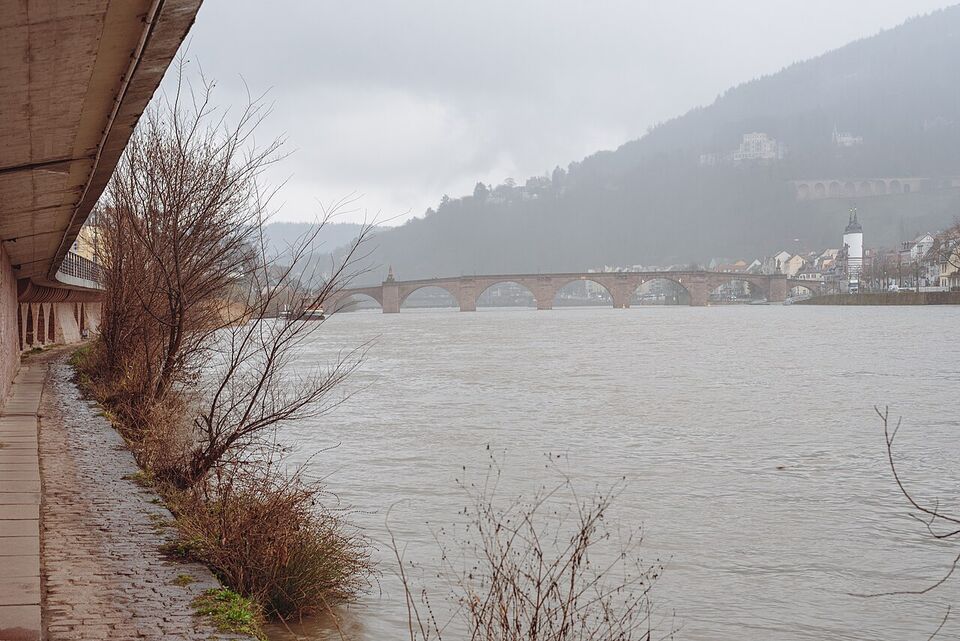
Overview: Germany's southwest in one loop
Heidelberg and the Black Forest make an easy first stop for anyone landing in Frankfurt. Heidelberg is a castle ruin above a student town, about an hour south by train. Beyond it, the Rhine plain runs south to Baden-Baden's spas and Freiburg's old town, and the forested hills rise behind them: dark spruce slopes, lakes, waterfalls, cuckoo clocks and cake.
The region works well in two ways. You can make Heidelberg a single day trip from the Frankfurt airport area, or you can build a loop of three to five days: Heidelberg, Baden-Baden, Freiburg, then a night or two in the forest itself. Almost all of it is reachable by train, but the high forest rewards a car.
This page covers the sights, what they cost, how the guest card works, trains versus a car, and where to sleep. If you are still deciding where this fits in a larger trip, see Plan Your Trip to Germany and the hub of Germany's destinations. For the Frankfurt end of the trip, see Frankfurt.
Different from home
The "Black Forest" is not one forest you can drive through in an hour. It is a mountain region about 100 miles (160 km) long and up to 37 miles (60 km) wide, with towns, farms and ski lifts inside it. Think of it the way you would think of the Catskills or the Smoky Mountains: a region to base yourself in, not a single park.
Heidelberg Castle
The castle ruin sits roughly 260 feet (80 m) above the old town and is the reason most people come. It was the seat of the Electors Palatine, and it was wrecked by French troops in the 1690s and then by lightning in 1764. Instead of rebuilding, the town left it as a ruin, which is how it became a symbol of German Romanticism in the early 1800s.
The castle ticket includes a round trip on the funicular (the Bergbahn) from the Kornmarkt station, the courtyard and terrace, the Great Tun (a wine barrel said to hold 220,000 liters, about 58,000 gallons) and the German Apothecary Museum. You can also walk up in 10 to 15 minutes by the steep Burgweg path from the old town.
Tickets and hours
| Item | Price | US$ (approx.) | Notes |
|---|---|---|---|
| Castle ticket, adult (to December 31, 2026) | €11 | $12 | Includes funicular, Great Tun, Apothecary Museum |
| Castle ticket, reduced (to December 31, 2026) | €5.50 | $6 | Students and other eligible groups |
| Castle ticket, adult (from January 1, 2027) | €12 | $13 | Reduced €6 (about $7) |
| Guided tour of the interior | €6 | $7 | Reduced €3; the castle interiors are open on guided tours only |
| Audio guide | €6 | $7 | English and seven other languages |
The castle grounds, terrace and big barrel cellar are open daily from 9 a.m. to 6 p.m., with last admission at 5:30 p.m. The ticket desk closes at 5:15 p.m. English tours generally leave 15 minutes past the hour, with the exact schedule shortened in winter. The castle is closed on December 25, has short hours on December 24 and 31, and opens late on January 1. Check the castle's official visitor page before you go.
The funicular is the time-sensitive part. Heidelberg's city council was due to decide in October 2026 on a plan to halt the funicular from early October 2027 to the end of March 2028 while bridge work happens near the castle approach, with replacement buses planned. We could not confirm the outcome, so if you travel in that window, check the Bergbahn site, and plan to walk up.
Insider tip
Decide in advance whether you want the tour. The interiors (the Ottheinrich building, the Friedrich wing) are visited on a guided tour only, and the tour is an add-on. If you only want the ruin, the terrace view and the giant barrel, the basic ticket covers all of it, and you can spend the time in the old town instead.
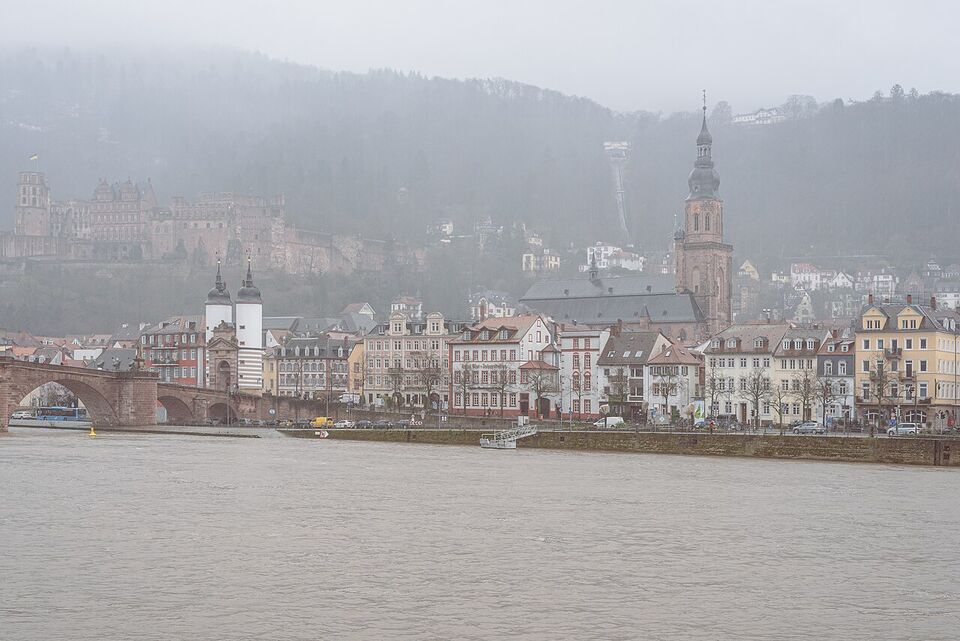
The old town, the Old Bridge and the Philosophers' Walk
Heidelberg's old town (Altstadt) is a long, mostly pedestrian street, the Hauptstraße, running about 1 mile (1.6 km) from Bismarckplatz to the Karlstor gate. It is lined with shops, bakeries and student pubs, with squares branching off it: the Marktplatz and the Heiliggeistkirche (Church of the Holy Spirit), the Kornmarkt below the castle, and the university buildings around the Universitätsplatz.
The Old Bridge (Alte Brücke), a stone arch bridge built in 1788, crosses the Neckar at the east end of the old town. Walk through its twin-towered gate and look back for the classic view of castle, bridge and river. A bronze monkey on the bridge gate is a photo stop. Crossing the bridge is free.
The Philosophers' Walk (Philosophenweg) is a path on the north side of the river, partway up the Heiligenberg slope. It is free, takes about 1 mile (1.6 km) to walk the main stretch, and gives the broadest view over the old town and the castle. The climb up to it is steep: the Schlangenweg ("snake path") from the bridge is a series of stone steps and switchbacks. Allow 1 to 1.5 hours for the whole circuit with stops.
The student prison
The student prison (Studentenkarzer) is a small detention cell block in the old university, used from 1712 until 1914 to lock up students for mild offenses such as noise, drunkenness and debts. The walls are covered with students' drawings and graffiti. It is a short, offbeat visit (about 20 minutes) with a small entry fee of a few euros. Hours are limited and seasonal, so check the University of Heidelberg's visitor information before you plan around it.
Heidelberg as a day trip from Frankfurt
Heidelberg is one of the easiest day trips in Germany. Trains from Frankfurt Hauptbahnhof (main station) take about an hour to Heidelberg Hauptbahnhof, with faster ICE trains and slower regional trains both running. From the Frankfurt airport train station (Fernbahnhof), the trip is similar. If you arrive in the morning on a transatlantic flight, you can be in Heidelberg by early afternoon.
Heidelberg's station is about 1.5 miles (2.4 km) from the middle of the old town. A bus or tram to Bismarckplatz takes about 10 minutes, then you walk in. Check the exact fare when you buy; regional tickets and the Deutschlandticket both work. For a train ticket primer, see German Train Tickets and Passes.
- A full day
Heidelberg from Frankfurt
Take a train that leaves Frankfurt around 8 to 9 a.m. Walk or ride to Bismarckplatz and stroll the Hauptstraße. Take the funicular to the castle by about 10:30 a.m. and join an English tour. Eat lunch in the old town. Cross the Old Bridge, climb to the Philosophers' Walk in the afternoon, and catch a train back to Frankfurt around 6 to 7 p.m.
If you want a night, Heidelberg is better after the day-trippers leave. Evenings are lively because of the university. The Heidelberg lodging tax is €3.50 (about $4) per person per night, usually added to your hotel bill. The Heidelberg Christmas market runs in six old-town squares, with dates published as November 23 to December 22, 2026 (a local news report, so confirm on the city's site).
Baden-Baden: spas, the Friedrichsbad and the Caracalla
Baden-Baden is a spa town on the edge of the Black Forest, famous since Roman times for hot springs and since the 1800s for its casino, its promenade along the Lichtentaler Allee, and its bathhouses. It is about 1.5 hours by train from Frankfurt. The main station is several miles from the center (about 3 miles or 5 km), so plan on a bus or taxi for the last stretch.
The question most Americans ask is about swimsuits. The short answer: the Friedrichsbad requires none, and the Caracalla Therme is the opposite for the main pools.
Friedrichsbad
The Friedrichsbad is a Roman-Irish bath built in the 1800s, with 17 stations, from warm and hot air rooms to steam, showers, soap-brush massage, thermal pools and a cold plunge. It is textile-free on most days, which means you wear nothing in the bath itself. It costs €39 (about $44) for the circuit, with bath shoes, towels, shampoo and lotion included. The soap-brush massage costs extra. Visitors must be 14 or older.
The bath is open daily from 9 a.m. to 10 p.m., with last entry three hours before closing, so the latest start is 7 p.m. Allow about three hours. It is closed on December 24 and 25, open until 8 p.m. on December 31, and opens at 11 a.m. on January 1. Whether a particular day is a mixed day or a men's or women's day is posted on the bath's calendar, and one third-party listing says swimwear is required on Wednesdays and Saturdays. We could not confirm that on the official page, so look at the calendar for your date before you go.
Etiquette is simple: you shower first, you follow the numbered route through the stations, and you do not take photos. Staff will give you a sheet or towel to wrap yourself in when moving between stations. Nudity here is matter-of-fact, not sexual. If you are uncomfortable, choose Caracalla instead.
Caracalla Therme
The Caracalla Therme is a modern thermal bath complex next door. The main pools require swimwear, and there are indoor and outdoor pools, a sauna landscape and a children's area. The sauna area is textile-free, and in the sauna world you sit on a towel and stay quiet. A third-party listing gives roughly €20 to €25 (about $22 to $28) for two hours of pools, and a bit more with the saunas; that listing may be out of date, so check the Caracalla's own price page. Children under 7 are not admitted to the main bath area.
Watch out
Do not bring a swimsuit to the Friedrichsbad on a textile-free day and expect to wear it. Expect to be asked to remove it, or to be turned away. And leave your phone in a locker: photos are not welcome in either bath's bathing areas.
For a wider look at German sauna customs (towel rules, nudity, quiet), see German Etiquette.
Freiburg: the Münster, the Bächle and a base for the forest
Freiburg is a university city of about 230,000 people at the western edge of the Black Forest, and it is one of the warmest and sunniest places in Germany. It is the best base for the southern forest: the old town is walkable, trains run into the hills, and the cable car to the Schauinsland leaves from the edge of town.
The Freiburg Münster (cathedral) is a Gothic church with an open-work spire that survived the 1944 bombing of the city. On every day except Sunday, a market fills the square around it, selling vegetables, flowers and the regional sausage (Lange Rote) in a roll. You can climb the tower for views over the old town and the Rhine plain; check the cathedral's site for the current ticket price and hours.
The Bächle are narrow water channels that run along many old-town streets, once used to supply water and fight fires. Locals step over them. The old folk saying is that if you step in one by accident, you will marry a Freiburger, so expect a little teasing. It is also why you should watch your step.
Freiburg's lodging tax is 5% of the net room price. The Freiburg Christmas market is usually held on the Rathausplatz in the weeks before Christmas; dates were not confirmed for this guide, so check the city's site.
Schauinsland cable car
The Schauinslandbahn is a cable car that climbs to the Schauinsland summit, 4,213 feet (1,284 m), about a 20-minute ride from the edge of Freiburg. The cable car operates daily from 9 a.m. and runs only in suitable weather (it stops in strong wind or thunderstorms), with a status notice posted at the top of its website. It is closed for annual maintenance from November 16 through December 4, 2026, and reopens on December 5 with a Christmas program. We could not confirm 2026-27 fares, so check the Schauinslandbahn site. At the top, a network of trails leads over the ridge, and in winter there is a small ski area with a few lifts when snow allows.
Titisee, Triberg and the high forest
Titisee
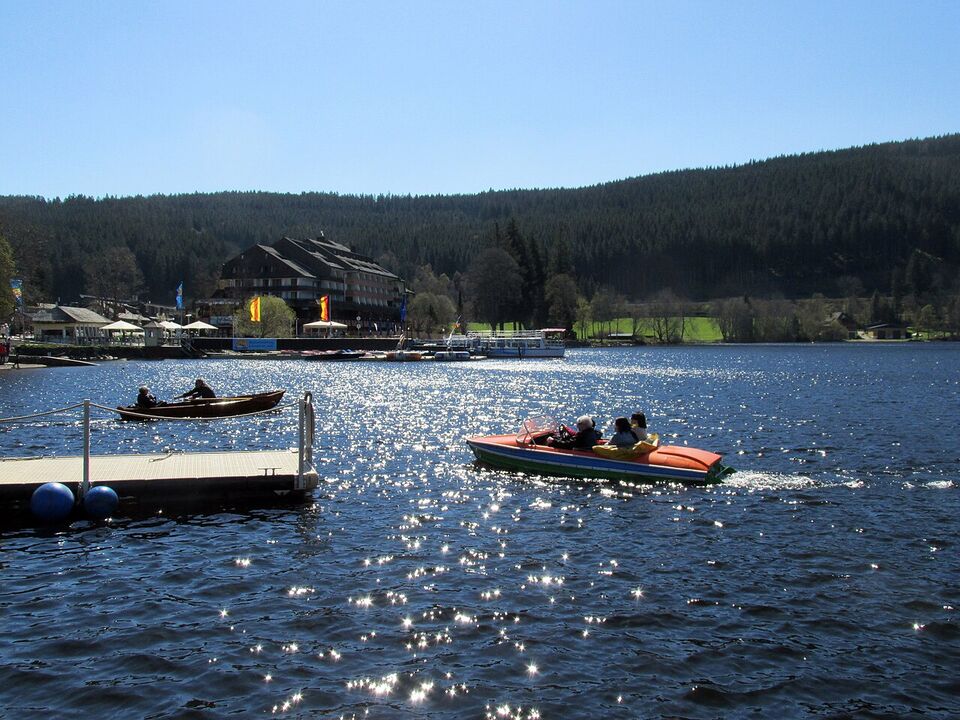
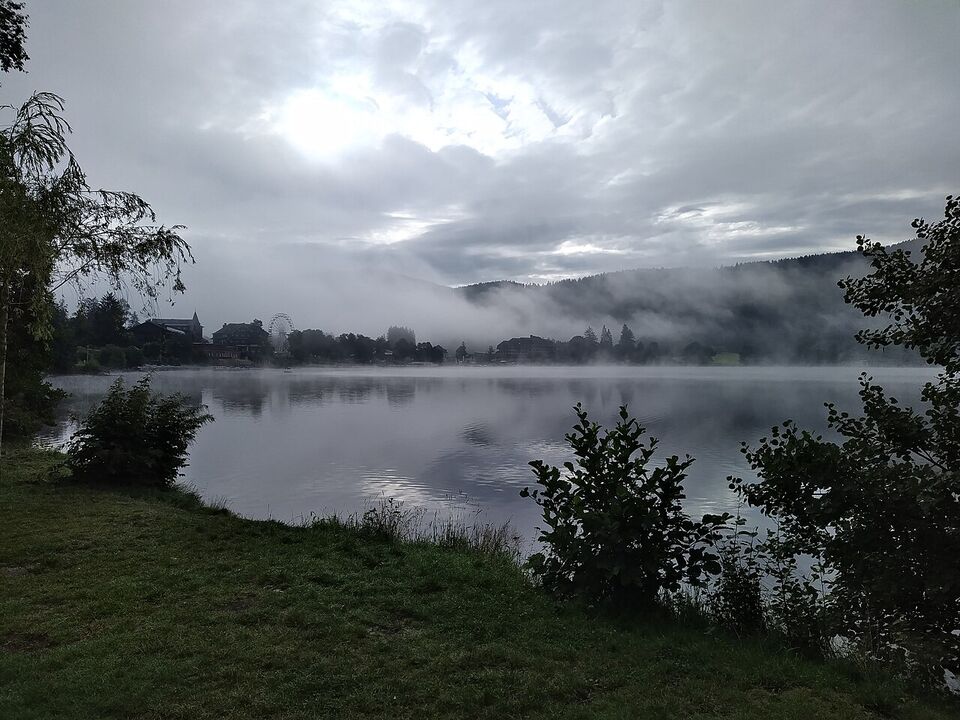
Titisee is a glacial lake at 2,815 feet (858 m) in the town of Titisee-Neustadt. It is the Black Forest's best-known postcard and also its most commercial: the lakeside is lined with souvenir shops, cafes and cuckoo-clock stores, and it is busy on summer weekends. You can walk the shoreline in about an hour, rent a rowboat or take a lake boat, and swim in summer in the signed bathing spots. The Höllentalbahn train from Freiburg runs to Titisee in about 40 minutes, a pretty ride through a gorge.
Above Titisee, the Feldberg is the highest peak in the Black Forest, at 4,898 feet (1,493 m). It has hiking in summer and downhill skiing in winter when snow allows. For the ski side, see Hiking, Cycling and the Outdoors.
Triberg waterfalls and cuckoo clocks
Triberg is a small town built up a steep valley, known for its waterfalls and its clock shops. The falls drop a total of about 535 feet (163 m) in seven stages beside a forest path, and they are among the highest falls in Germany. There is a small admission fee at the main entrance (we could not confirm the current amount). The walk takes about an hour and has steep steps, so wear shoes with grip. In the weeks around Christmas, the falls are sometimes lit at night; check the town's site for dates.
Triberg and its neighbors (including Schonach and Furtwangen) are the center of cuckoo-clock country. A cuckoo clock is a carved wooden clock with a bird that pops out on the hour. Real Black Forest clocks are made by hand and cost from a few hundred euros up to several thousand; much cheaper ones are factory-made and may come from elsewhere. If the maker is local, the shop will say so and show you the workshop. Two cautions: a clock is fragile and heavy for a flight, so ask the shop to pack and ship it, and keep your VAT refund paperwork if you take it home (see Money in Germany).
The Black Forest Railway (Schwarzwaldbahn) from Offenburg to Konstanz climbs through the forest with many tunnels and passes through Triberg. It is one of Germany's classic scenic regional lines. Triberg's station sits below the town, so allow about 15 minutes uphill on foot or take a bus.
Black Forest cake
Black Forest cake (Schwarzwälder Kirschtorte) is chocolate sponge layered with whipped cream and sour cherries, finished with chocolate shavings and soaked with Kirschwasser, a clear cherry brandy. By German food guidelines for the name, the real thing has to include that spirit. It is served in the region's cafes by the slice for about €5 to €7 (about $6 to $8), though prices vary by town. If you do not want alcohol, ask whether the cake is made with it, since most traditional recipes are.
Save money
Buy cake and coffee at a village bakery rather than a lakeside tourist cafe. The cake is the same type of cake, and the price is often lower, with fewer tour buses. Pay with euros in cash at small bakeries, since many do not take foreign cards. See Money in Germany.
The Black Forest High Road (B500)
The Schwarzwaldhochstraße, Federal Road B500, runs along the northern Black Forest ridge from Baden-Baden to Freudenstadt, about 37 miles (60 km). It climbs above 3,000 feet (900 m) and passes overlooks, small lakes and trailheads. The Mummelsee, a small glacial lake at about 3,400 feet (1,036 m), is the best known stop, with a restaurant and a short loop trail. Hornisgrinde, at 3,819 feet (1,164 m), is the highest point in the northern forest and has a lookout tower.
The road is two-lane, with curves and slow traffic on summer weekends. Allow 1.5 to 2 hours for the drive without stops, and a half day with stops. In winter the road can be snowy or icy; the German winter-tire rule applies (see Driving in Germany). It can close for snow, so check road conditions before you set out. There is no bus that follows the whole road, so this is a drive-yourself route.
The Black Forest National Park covers part of this ridge near the B500, with marked trails and a visitor center. It is free to enter. Dogs must be on a leash.
Also in the region: the Black Forest Open Air Museum (Vogtsbauernhof) near Gutach, a group of old farmhouses, is seasonal, so check its dates for the month you travel.
Trains versus a car
You can do the main loop without a car. Heidelberg, Baden-Baden, Freiburg, Titisee (via the Höllentalbahn) and Triberg (via the Black Forest Railway) all have train stations, and the Deutschlandticket (€63 a month in 2026, about $71, rising to €66.80 or about $75 on January 1, 2027) covers regional trains and buses, though not ICE or IC trains. The Deutschlandticket is mostly a bargain for people staying at least a couple of weeks, and the usual single tickets and regional day tickets work for shorter trips. See German Train Tickets and Passes.
| Trip | By train | By car |
|---|---|---|
| Frankfurt to Heidelberg | About 1 hr | About 55 miles (90 km), 1 hr |
| Heidelberg to Baden-Baden | About 1 hr 15 min, usually one change in Karlsruhe | About 65 miles (105 km), 1 hr 15 min |
| Baden-Baden to Freiburg | About 50 min to 1 hr | About 70 miles (115 km), 1 hr 15 min |
| Freiburg to Titisee | About 40 min (Höllentalbahn) | About 20 miles (32 km), 40 min |
| Titisee to Triberg | About 1.5 hr with a change | About 30 miles (50 km), 1 hr |
Times are typical and rounded; check Deutsche Bahn for your date. A car helps for the B500, small villages and mountain trailheads, and it lets you stop at lookouts. It is a nuisance in Heidelberg and Freiburg, where old-town parking is limited and pedestrian zones are common. A common compromise is to take trains between Heidelberg, Baden-Baden and Freiburg, then rent a car for a day or two in the forest. For rules, see Driving in Germany and Getting Around Germany.
The KONUS guest card
KONUS is a free guest card that gives unlimited rides on regional buses and trains in the Black Forest (second class) during your stay. You get it at check-in from a participating hotel, guesthouse or campsite. About 150 destinations take part. It also covers buses and trams in Freiburg and Karlsruhe. It does not cover ICE, IC or EC long-distance trains, mountain railways or ski lifts.
It is valid from check-in to your departure day, and the card is personal: have your photo ID with you. Some lodgings cannot issue it, including some youth hostels and clinics, so ask before you book. Under the 2027 framework the region has agreed, KONUS is due to cover your arrival within the KONUS area too, and the digital version should be available in all participating towns by the end of 2026. Because this is a change in progress, confirm the current terms with your hotel.
Insider tip
If you plan to use trains in the forest, make "Does your hotel give the KONUS card?" one of your booking questions. A week of free regional transport can save more than the price difference between two hotels, and it removes the need to buy tickets in a language you may not read yet.
Where to stay
Choose by what you want to do, not by price alone.
- Heidelberg old town: best for walking to the castle and nightlife. Rooms are typically in the $$ tier, higher on weekends in spring and fall. Near the station is cheaper but less atmospheric.
- Baden-Baden: from $$ in a mid-range hotel to $$$ for a grand spa hotel. A hotel with its own bath is a different experience from a day ticket to the Friedrichsbad.
- Freiburg: the best base for a mix of city and hills, mostly $$. Book early for weekends and for the weeks around Christmas.
- Titisee and the villages: guesthouses, family-run hotels and holiday apartments, mostly $ to $$. Most take part in KONUS.
- Triberg: small, quiet, good for a night if you want the waterfalls without the day-trip crowd.
These price tiers are our rough guide to a double room and move with the season and events. For a guide to hotels, guesthouses and city taxes across Germany, see Where to Stay in Germany.
Strasbourg and other side trips
Strasbourg, in France's Alsace region, is about an hour from Baden-Baden or Freiburg by train. It has a Gothic cathedral, a half-timbered district called Petite France and a long Christmas-market tradition. It is a good day trip if you have a spare day. The euro is used in France as well. The trip crosses the Rhine, and Germany has temporary border controls on its land borders, so carry your passport on any cross-border train or drive (see Germany and Its Neighbors).
Europa-Park, near Rust about 25 miles (40 km) north of Freiburg, is Germany's biggest theme park. Adult day tickets were roughly €67 to €76 (about $75 to $85) when bought online, with the box office adding €10 (about $11). Its winter season is scheduled for November 28, 2026 to January 9, 2027, and it is closed on December 24 and 25. The figures come from a third-party source, so confirm them on the park's own site.
If you are moving on from here, Lake Constance is the natural next stop (see Lake Constance), and the Rhine valley lies north (see The Rhine and Moselle). To add a castle, see Castles and Palaces in Germany.
When to go and a sample route
May to June and September to October are the best months: warm days, green or golden hillsides, and lighter crowds than July and August. December is good for Christmas markets, thermal baths and snowy forest walks, though the days are short. Heavy snow can shut the B500 and some forest roads, and some summer attractions close for the season.
- Day 1
Heidelberg
Arrive from Frankfurt, walk the Hauptstraße, do the castle and tour, cross the Old Bridge and walk the Philosophers' Walk before dinner.
- Day 2
Baden-Baden
Take the train to Baden-Baden. Book a Friedrichsbad slot for the afternoon, walk the Lichtentaler Allee, and stay the night.
- Day 3
Freiburg
Train to Freiburg for the Münster, the market and the Bächle. Ride the Schauinsland cable car if the weather is clear (not between November 16 and December 4, 2026, when it is closed for maintenance).
- Day 4
Titisee and Triberg
Take the Höllentalbahn to Titisee, then continue by bus or car to Triberg for the waterfalls, a clock shop and a slice of cake. Add the B500 if you have a car.
Hiking or cycling here is excellent too, and the Black Forest has well-marked long-distance trails. See Hiking, Cycling and the Outdoors for trails, hut etiquette and tick precautions.
Add it to a route in the trip builder, or ask us to plan the hotels, trains and guides for you.