Overview: Dresden in two days, Saxony in four
Dresden is worth a stop, and two days is the right amount for most visitors. The city sits on the Elbe river in Saxony, in the east of Germany, about 120 miles (190 km) south of Berlin. Its old town was flattened in the bombing of February 13-15, 1945, then rebuilt stone by stone over decades, so what you see on the skyline is partly new and partly very old. The result is one of the most photogenic riverfronts in Germany.
The famous sights are close together. The Frauenkirche, the Procession of Princes, the Royal Palace with the Green Vault, the Zwinger and the Semperoper are all within a ten-minute walk of one another, so you can see them without using transit. That makes Dresden easy for a first-time visitor, and good for people who do not want to drive.
Beyond the city, Saxony rewards a second and third day. Meissen, the home of German porcelain, is about 15 miles (25 km) away. Saxon Switzerland, a sandstone landscape with the Bastei bridge, starts about 20 miles (30 km) south-east. Leipzig, with its Bach and 1989 history, is a little over an hour away by train. If you are building a wider route, see our guides to Berlin, Weimar, the Wartburg and the Harz, Nuremberg and Germany's destinations.
Getting there and getting around
Dresden is on the main rail line between Berlin and Prague. The fast train from Berlin takes about 2 hours, and trains from Leipzig take roughly 1 hour 10 minutes to 1 hour 20 minutes. From Munich, expect a longer day, usually with a change in Leipzig or Nuremberg, so check the exact connection at bahn.de. Trains to Prague run along the Elbe valley and take roughly 2.5 hours. For fares, saver tickets and seat reservations, read German train tickets and passes and Getting around Germany.
Arrive at the Hauptbahnhof (main station), which is south of the old town. A walk to the Altmarkt and the Frauenkirche takes about 15 to 20 minutes, or you can take a tram. The Neustadt station on the north bank is closer to the Neustadt district, and some regional trains stop at both. Dresden has an international airport, but few visitors from the US use it, and most connect through Frankfurt, Munich or Berlin.
Within the old town, you will mostly walk. For the Neustadt, Meissen and the Elbe valley, the transit operator is VVO (vvo-online.de). Its S-Bahn line S1 is the one you need: it runs from Meissen through Dresden and up the Elbe to Bad Schandau and the Czech border. The Deutschlandticket (€63 a month in 2026, about $71, rising to €66.80, about $75, on January 1, 2027, per Deutsche Bahn) generally covers regional trains and S-Bahn, but it is a monthly subscription and not always worth it for a short stay, so check our ticket guide before buying.
Different from home
Dresden, like most of eastern Germany, was part of East Germany until 1990. You will notice wide Soviet-era boulevards next to rebuilt baroque streets, and a very different feel from Bavaria. Dresden also adds a hotel tax of 6% of the room price, so expect it on your bill (check whether your booking includes it).
The Frauenkirche
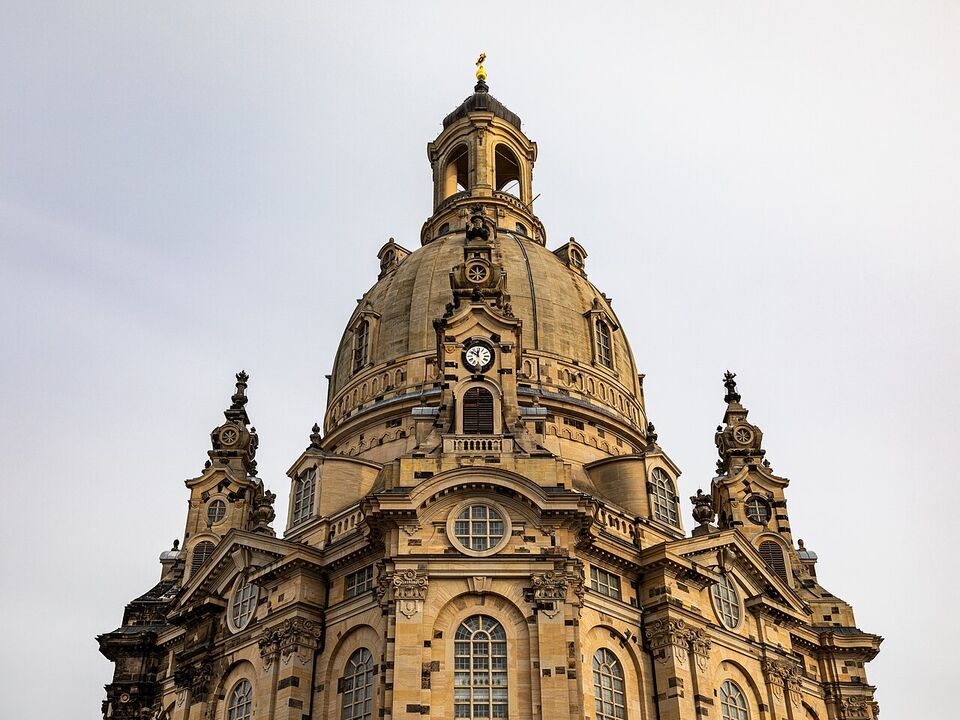
The Frauenkirche (Church of Our Lady) is the symbol of Dresden. The baroque Lutheran church was finished in the 1700s, and its great stone dome, called the "Stone Bell," was one of the largest in Europe. It collapsed on February 15, 1945, after the bombing, and the ruins lay in the city center for almost fifty years as a war memorial. Reconstruction began in 1994, using as many of the original blackened stones as could be recovered, and the church was reconsecrated on October 30, 2005. The gold cross on top was made in London and paid for by British donors, a gesture of reconciliation.
Hours, tickets and the dome
Visiting the interior is free during "open church" hours, with a donation requested at the entrance or exit. Hours are generally Monday to Friday from 10 a.m. to 11:30 a.m. and 1 p.m. to 5:30 p.m. The church closes at midday, and weekend hours change often because of services, concerts and rehearsals, so check the event calendar on the Frauenkirche website on the day you plan to go.
To climb the dome for a view over the old town, tickets are sold at entrance G or online through a ticket partner. Online prices start at about €13 (about $15) including the booking fee, with a lower rate for students and children. Evening concerts and organ recitals are a good way to see the interior in the quiet; the box office is at entrance D. Dome hours and prices change by season, so verify them before you go.
Insider tip
If the church is shut at midday, use the gap. Walk around the outside to see the dark and light stones, the older blackened pieces set into the pale new sandstone. It is easy to read the pattern from the Neumarkt square, and it is free.
The old town on foot: Procession of Princes, Brühl's Terrace and the Semperoper
From the Frauenkirche, a short walk covers three of the best-known sights. First, the Fürstenzug (Procession of Princes) is a huge mural on the wall of the Stallhof, along Augustusstraße. It shows 35 rulers of the House of Wettin, from the 1100s to the 1900s, on horseback, followed by scientists, artists, children and farmers. It is about 335 ft (102 m) long and made of roughly 23,000 Meissen porcelain tiles, which is why it survived the 1945 bombing with little damage. It is outdoors and free, and early morning is the least crowded time.
Second, Brühl's Terrace is a raised promenade along the Elbe, nicknamed the "balcony of Europe." It is free, open all day and good for sunset. From there you can see the river, the Neustadt on the opposite bank and the Elbe paddle steamers, which mostly run from spring to autumn. Check the operator's schedule if you want a boat trip in winter.
Third, the Semperoper is Dresden's opera house, rebuilt twice after fires and war. Guided tours run almost every day in German and English, with a short 30-minute tour before some performances. The opera's page does not list prices or fixed times, so contact the house (+49 351 4911 705) or check semperoper.de before you plan around it. An evening performance is the best way to see the interior, and tickets are sold on the same site.
The Residenzschloss and the Green Vault
The Royal Palace (Residenzschloss) was the home of the Saxon rulers, and the museum complex inside holds the Green Vault, one of the richest collections of treasure in Europe, put together in the 1500s and 1700s by the Saxon kings. The palace was also rebuilt after the war and is open Wednesday through Monday; it is closed on Tuesdays.
The Green Vault is split into two parts, and the difference matters for your ticket. The Historic Green Vault is the baroque set of rooms, reached with a timed ticket and a free audio guide. The New Green Vault shows the same collection in modern galleries and is included in the general Royal Palace ticket. If you want only one, the Historic Green Vault is the more spectacular, but because the New Green Vault is open with a regular ticket, it is the easier one to see on short notice.
| Ticket (2026) | Adult | Reduced | Notes |
|---|---|---|---|
| Royal Palace ticket | €18 (about $20) | €13.50 (about $15) | Includes the New Green Vault, Armoury, State Apartments and more; not the Historic Green Vault |
| Historic Green Vault, timed ticket | €18 (about $20) | €13.50 (about $15) | Audio guide included; limited capacity |
| Combination ticket | €28 (about $31) | Check the shop | Palace plus Historic Green Vault |
| Palace chapel tour (German) | €10 (about $11) | €7.50 (about $8) | About 60 minutes |
The ticket prices in this table are the ones we found listed for 2026 (the museums' own price pages did not load for us), so confirm them in the shop. Reduced rates for pupils and free entry for young children are listed there too. Tickets are sold in the museums' online shop at skd.museum. As reported by ticket sellers, the Historic Green Vault runs Wednesday to Monday, generally 10 a.m. to 6 p.m., and the New Green Vault stays open until 7 p.m. on Fridays. A Friday evening session called "Blue Hour" has been listed for the Historic Green Vault for about €21 (about $24), but confirm that on the official shop. From November 27 to December 30, 2026, the museums list extra Historic Green Vault opening on Fridays to Sundays, which helps if you are visiting during the market.
Watch out
Use the official museum shop, not resellers. Third-party sites sell the same tickets at a markup or with fees, and the official page is the only one that shows live availability. The Historic Green Vault does not sell day tickets that bypass the time slot, so a general Royal Palace ticket will not get you in.
The Zwinger and Dresden's museums
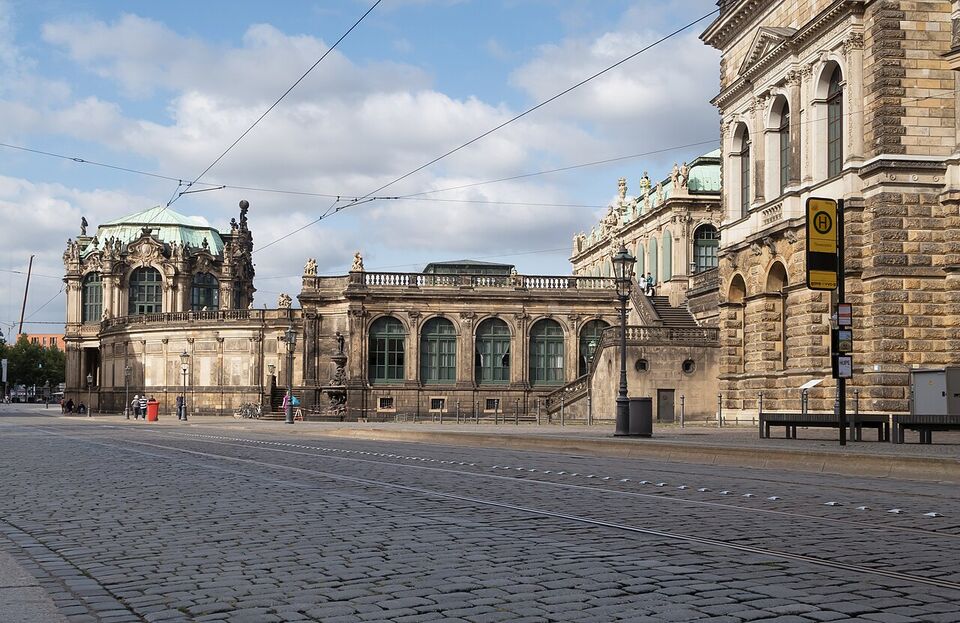
The Zwinger is a baroque palace complex built for Augustus the Strong, with a large courtyard that is free to enter at any time. Inside its pavilions are three museums. The courtyard alone takes 20 minutes. If you want the museums, the best-known one is the Old Masters Picture Gallery, which includes Raphael's Sistine Madonna. The porcelain collection and the Mathematics and Physics Salon (with historic clocks and instruments) are in the same complex.
In 2026 the Zwinger museums are closed on Mondays. A house ticket covering the picture gallery, the sculpture collection, the salon and the porcelain collection is listed at about €18 (about $20), or €13.50 (about $15) reduced. The Salon and the porcelain collection can also be bought alone for €6 (about $7). Because of building work, the porcelain collection is charging the reduced rate from October 31 to December 31, 2026. A special Correggio exhibition has a separate timed ticket, so check which exhibitions are on when you book. All of this is on the Dresden State Art Collections site.
Old Masters Picture Gallery
The best fine-art museum in the city. Raphael's Sistine Madonna and its famous pair of cherubs are the draw.
Porcelain Collection
Early Meissen and East Asian porcelain collected by the Saxon rulers. It pairs well with a Meissen day trip.
Mathematics and Physics Salon
Clocks, globes and scientific instruments from the 1500s on. A quiet stop for a rainy afternoon.
Military History Museum
A national museum of German military history with a strong focus on the human cost of war. It is a tram ride from the old town; confirm hours before you go.
The Neustadt, the other side of the river
Cross the Augustus Bridge to the Neustadt (New Town), which survived the bombing more fully and has a different character from the old town. The Hauptstraße is a tree-lined boulevard, and the streets around Alaunstraße and the Kunsthofpassage are filled with cafes, independent shops and bars. The Kunsthofpassage is a set of courtyards decorated by local artists. Pfunds Molkerei, a dairy shop covered in hand-painted tiles, is a short walk away.
The Neustadt is a good place for dinner. Most restaurants here accept cards, but keep some cash for small bars and bakeries (see Money in Germany). Saxon food is hearty: expect potato soup, Sauerbraten (marinated pot roast) and regional cakes. For a general introduction to what you will find, read German food.
The Striezelmarkt and Dresden at Christmas
The Striezelmarkt on the Altmarkt is one of the oldest Christmas markets in Germany, and the city counts the 2026 edition as the 592nd. It runs from Wednesday, November 25 to Thursday, December 24, 2026. The opening day runs 4:30 p.m. to 9 p.m., then it is open daily 10 a.m. to 9 p.m., and on December 24 it closes at 2 p.m. The market is named for the Stollen (a dense fruit loaf, called Striezel in old Dresden dialect), and the city's Stollen festival is traditionally held on the Saturday before the second Advent Sunday, which would be December 5, 2026. Confirm that date with the city before planning around it.
At markets you pay a deposit (Pfand) of a few euros for the mug of mulled wine, which is refunded when you return it. Dresden's market is crowded on weekend evenings, so go on a weekday afternoon if you can. Hotels in the old town fill up for December weekends, so book early. For other cities and a route by train, see Christmas markets in Germany and Germany in December.
Meissen: the porcelain town
Meissen is about 15 miles (25 km) north-west of Dresden and sits on the Elbe. The S1 S-Bahn goes straight there from Dresden, roughly 40 minutes. The town is the home of the oldest European porcelain manufactory. It began in 1710 after Augustus the Strong brought in a chemist to find the secret of hard-paste porcelain, and the blue crossed-swords mark is still used today.
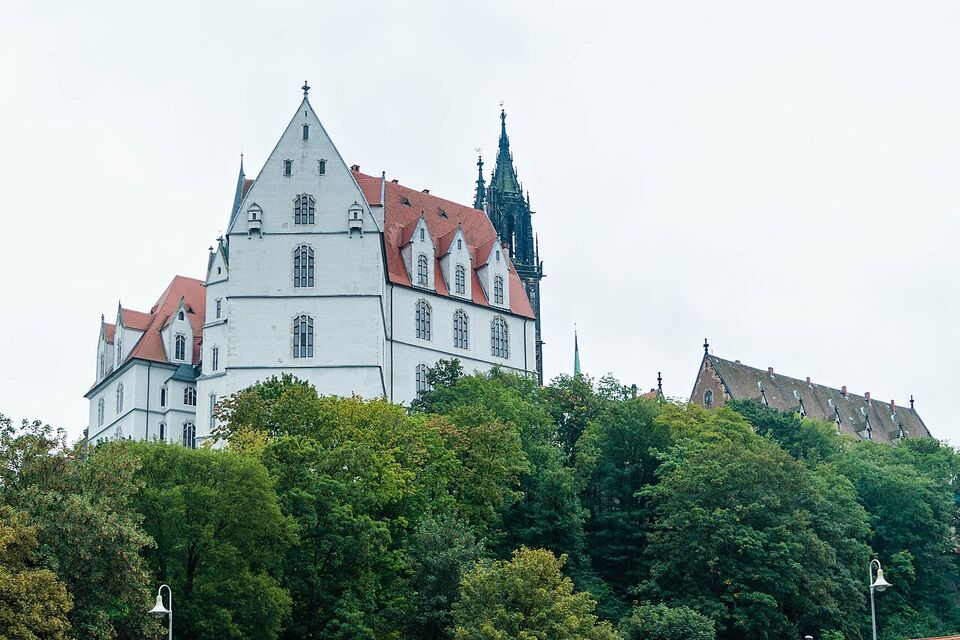
The manufactory has a museum and show workshops where you can see painters and potters at work. Check meissen.com for current hours and prices, which we could not confirm. Above the old town stands the Albrechtsburg, the first German castle built as a palace. In winter 2026/27 it is open Wednesday to Monday, 10 a.m. to 5 p.m., closed Tuesdays except on holidays, with an adult ticket of €12 (about $13) and a combination ticket with the manufactory at €24 (about $27). The upper floor is unheated, so dress warmly.
Meissen is easy to do in half a day, but a full day lets you add the cathedral and a walk through the old town. The Albrechtsburg and the cathedral have a combined ticket, and a three-day combined ticket with the manufactory also exists.
Moritzburg Castle
Moritzburg is a baroque hunting palace on a lake, about 10 miles (15 km) north-west of Dresden. The easiest public transport is a bus from the Dresden Neustadt area, and a narrow-gauge steam railway, the Lößnitzgrundbahn, also runs from Radebeul. Check both timetables at VVO since winter services differ from summer ones.
It is best known to many Germans as a filming location for the Czech-German Christmas film "Three Hazelnuts for Cinderella," and the castle holds a winter exhibition about it. The castle is closed November 2-19, 2026 to set up the exhibition. From November 20 it is open daily from 9:30 a.m. to 5:30 p.m. (last entry 4:15 p.m.), with later hours on Advent weekends. The winter exhibition, "3 Haselnüsse für Aschenbrödel," runs from November 20, 2026 to February 28, 2027. Tickets for it are sold online only, so book ahead. Full price is €12 (about $13), reduced €10 (about $11), and children 6-16 pay €4.50 (about $5). The castle is closed on December 24 and 31, and on several January and February dates, so check the official site.
Saxon Switzerland: Bastei, Königstein and the Elbe
Saxon Switzerland is a national park of sandstone cliffs, pinnacles and forests on both sides of the Elbe, extending to the Czech border. The area has about 750 miles (1,200 km) of marked hiking trails. The easiest route from Dresden is the S1 S-Bahn, which runs about twice an hour. Trains to Rathen, Königstein and Bad Schandau take roughly 30 to 55 minutes, depending on the stop and train.
The Bastei bridge
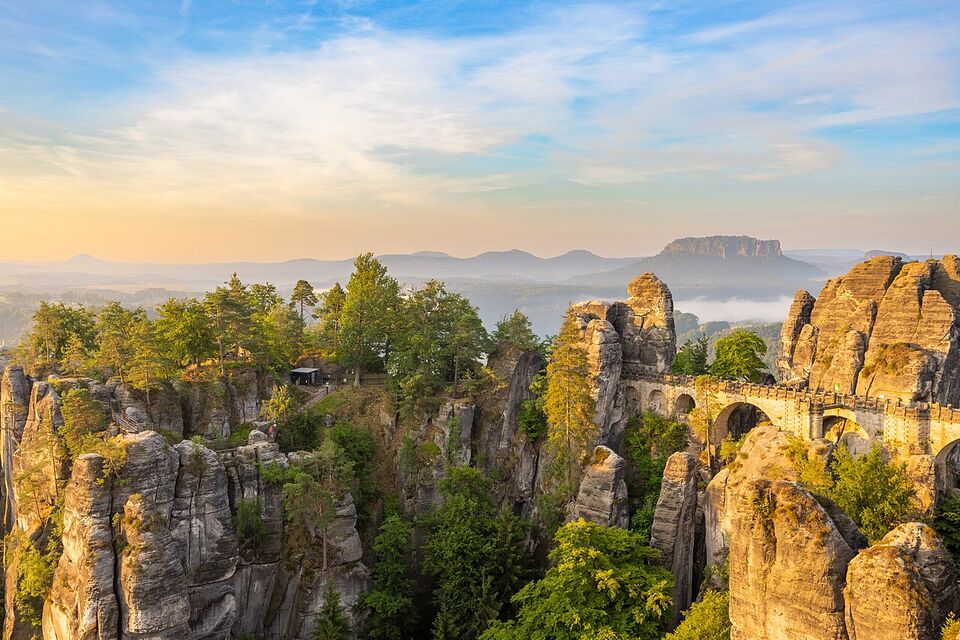
The Bastei is a rock formation about 636 ft (194 m) above the Elbe, with a seven-arch sandstone bridge built in 1851 that crosses a ravine to the ruins of the Neurathen rock castle. The best-known viewpoint is the platform on the cliff edge. The classic way up is to get off the S1 at Rathen, take the small passenger ferry across the river, then climb for about 30 to 45 minutes on a steep, partly stepped path. Some people drive to the Bastei plateau and walk from the car park, which is shorter but crowded in midday and in summer. Expect a small fee for the bridge and rock castle, and check the amount before you go.
In November through March, short days, wet stone and occasional ice make the paths slippery. Wear shoes with grip and leave time to get back before dusk. Fog can hide the views in winter, so check the forecast. Read Hiking, cycling and the outdoors for general trail safety.
Königstein Fortress
Königstein is a hilltop fortress about 790 ft (240 m) above the Elbe that was never captured. It served as a state prison for centuries and now houses exhibitions about its history. It has a 500-ft (152 m) well and elevators from the foot of the path. In winter the fortress is open 9 a.m. to 5 p.m., with last admission one hour before closing; prices were not listed on the pages we could read, so check festung-koenigstein.de. It is a good choice for a family because there is a lot to explore indoors.
Insider tip
For a first visit, pick one of the two: the Bastei for views and a short hike, or Königstein for a big fortress that works in bad weather. Doing both in one day means a lot of travel time and little time on the ground.
Leipzig: Bach, the Peaceful Revolution and a modern city
Leipzig is about 75 miles (120 km) west of Dresden and takes a little over an hour by fast train, so it works as a day trip in either direction or a stop between Dresden and Berlin or Weimar. It is a lively university city with a large central station, a compact center and a strong musical history.
St. Thomas Church and Bach
Johann Sebastian Bach was the cantor (music director) of the St. Thomas Church from 1723 until his death in 1750, and his grave has been in the chancel since 1950. The church is home to the Thomanerchor, a boys' choir that goes back more than 800 years. You can hear it at the Motette, a short sung service on Friday at 6 p.m. and Saturday at 3 p.m., and the printed program costs €3 (about $3). There are no tickets, and programs are handed out about 45 minutes before the start, so arrive early. Across the square, the Bach Museum is open Tuesday to Sunday and on public holidays from 10 a.m. to 6 p.m.; check the price on the museum's site.
Nikolaikirche and 1989
The Nikolaikirche (St. Nicholas Church) is where peace prayers held on Monday evenings grew, in autumn 1989, into the demonstrations that helped bring down the East German government. Peace prayers are still held there on Mondays at 5 p.m. The church is open Monday to Friday 11 a.m. to 6 p.m., Saturday 11 a.m. to 4 p.m., and Sunday 11:30 a.m. to 2:30 p.m., though visits are not possible during services and events. Check the posted schedule when you arrive.
Forum of Contemporary History
The Forum of Contemporary History (Zeitgeschichtliches Forum) is free and covers life in East Germany and the years since. The permanent exhibition, titled "Our History," follows dictatorship and democracy after 1945. It is open Tuesday to Sunday, 10 a.m. to 6 p.m. Combine it with a stop at the Nikolaikirche for a full picture of 1989. For the broader story, see History sites in Germany.
The Leipzig Christmas market runs from November 24 to December 23, 2026, with a hotel tax of 5% of the room price in the city.
Where to stay and how to plan
For a first visit, stay in the old town (Altstadt) or the Neustadt. The old town puts you within a few minutes' walk of the main sights, and the Neustadt has more restaurants and bars at lower prices. Hotels near the Hauptbahnhof are practical for early trains and are generally cheaper, although the area is less pleasant at night. Prices vary a lot by season, and December weekends cost the most. Use these tiers: $ for under $120 a night for a double, $$ for $120 to $300, and $$$ for over $300. Most good mid-range hotels in Dresden fall in the $$ band in high season and $ in winter. For wider advice, see Where to stay in Germany.
- Day 1
Old town
Start at the Frauenkirche (free hours), walk to the Procession of Princes, then spend the late morning in the Royal Palace and the Green Vault. Lunch near the Altmarkt. In the afternoon, visit the Zwinger and the Old Masters gallery, then walk along Brühl's Terrace at sunset. Book the Historic Green Vault for the morning.
- Day 2
Neustadt and Meissen or Moritzburg
Take the S1 to Meissen in the morning for the Albrechtsburg and the porcelain, and be back in Dresden for dinner in the Neustadt. In winter, Moritzburg's exhibition is an alternative.
- Day 3
Saxon Switzerland
Take an early S1 to Rathen, climb to the Bastei, then continue to Königstein if the weather and daylight allow.
- Day 4 or night
Leipzig
Train to Leipzig in the morning, Nikolaikirche and the Forum of Contemporary History before lunch, and the Thomaskirche in the afternoon. If you can, plan the trip to catch the Friday or Saturday Motette.
Save money
The Royal Palace ticket and the Zwinger house ticket are each about €18 (about $20), so a day of museums adds up. Pick the Green Vault plus one more museum rather than all of them. Children and teens often pay a small fixed price (the museum shop lists reduced rates), and the Frauenkirche, the Procession of Princes, Brühl's Terrace and the Zwinger courtyard cost nothing.
Before you go
- Book the Historic Green Vault time slot on the official museum shop.
- Check the Frauenkirche event calendar for the day you plan to go inside.
- If you visit in winter, check Moritzburg and Königstein hours, which differ from summer.
- Carry a little cash for bakeries and small cafes.
- Book a hotel early if you are visiting during the Striezelmarkt.
Add it to a route in the trip builder, or ask us to plan the hotels, trains and guides for you.