Overview
Nuremberg (Nürnberg) is the second-largest city in Bavaria and the capital of the northern region called Franconia. It has two sides. One is a medieval imperial city with a castle, a walled old town, a famous Christmas market, gingerbread and tiny grilled sausages. The other is a city that the Nazis chose for their party rallies and where the Allies later held the war crimes trials. Visitors can see both, and the second matters as much as the first.
Plan two days. Spend one on the old town, the Imperial Castle and the museums, and one on the Rally Grounds and the Memorium of the trials. Nuremberg lies on the fast rail line between Munich and Berlin, so it fits easily into a longer trip. If you are tracing a route, it is also the closest big city to the northern end of the Romantic Road. This page covers the old town and castle, the Dürer House, the Documentation Center, the Memorium, the Germanisches Nationalmuseum, food, the Christmas market, Bamberg and how to get there.
The old town
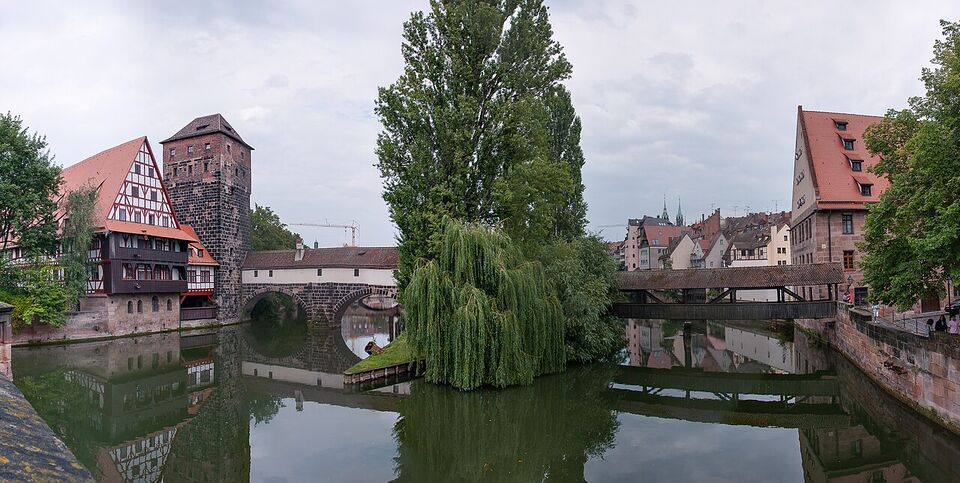
The old town (Altstadt) sits inside a ring of medieval walls about 3 miles (5 km) around, with the river Pegnitz running through it. Most of it was destroyed in an air raid on January 2, 1945, and then rebuilt in a style close to the old one, which is why the half-timbered houses look so complete and are mostly postwar reconstructions. Parts of the city's walls and towers survived and can be walked.
Hauptmarkt
The market square holds the Gothic Church of Our Lady (Frauenkirche) and the Beautiful Fountain (Schöner Brunnen), a tall, spired fountain with a gilded ring that visitors are said to turn for luck. It is also the site of the Christmas market in winter and a daily produce market on weekdays.
St. Sebaldus and St. Lorenz
Two Gothic churches stand on either side of the Pegnitz. Both have carved altars and sculptures. Entry is usually free, though donations are welcome. They are closed to sightseers during services.
Imperial Castle
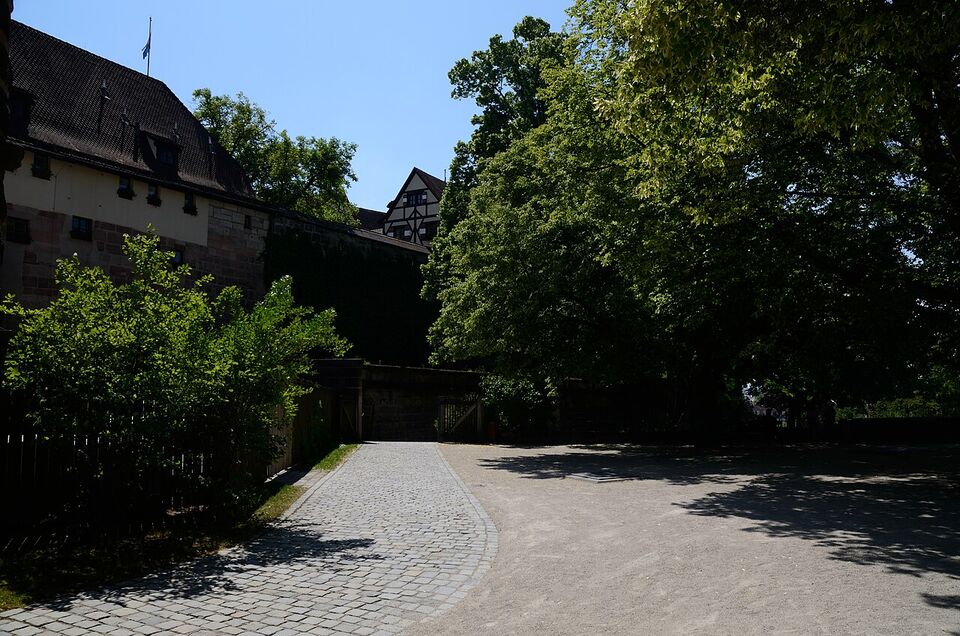
The castle (Kaiserburg) was a residence of the Holy Roman emperors. See the section below for tickets and hours.
Albrecht Dürer's House
The home and workshop of the Renaissance artist, now a museum. See the section below.
Handwerkerhof and city walls
The old town's walls and towers near the station are free to see from outside. A craft courtyard near the main gate is aimed at tourists. Check hours before you go.
The Imperial Castle
The Imperial Castle (Kaiserburg) stands on a sandstone ridge at the north edge of the old town and is the best viewpoint over the red roofs. It was a stop for the Holy Roman emperors from the 11th century on. The Bavarian Palace Administration runs it, and the 2026 price list shows admission at €7 (about $8), or €6 (about $7) reduced, and a combined ticket (Gesamtkarte) at €10 (about $11), or €9 (about $10) reduced. The Deep Well (Tiefer Brunnen) costs €4 (about $4) on its own. Visitors under 18 enter free. The price list does not say which parts each ticket includes, so ask at the ticket desk, or contact the castle administration, before you decide.
- Hours: October to March, 10 a.m. to 4 p.m.; April to September, 9 a.m. to 6 p.m. Closed on January 1, Shrove Tuesday and December 24, 25 and 31.
- Burggarten: the castle garden is open from April to October, from 8 a.m. until dusk.
- Audio guide: available for a fee in English and several other languages.
- Access: an elevator serves only the Knights' Hall in the Palas. Other rooms need stairs. The courtyard and the Deep Well can be visited.
- Getting there: a 10-minute uphill walk from the Hauptmarkt, or take tram to Tiergärtnertor, bus to Burgstraße or the U-Bahn to Lorenzkirche.
Albrecht Dürer's House
Albrecht Dürer (1471-1528) is Nuremberg's best-known artist, famous for his prints, drawings and self-portraits. He lived and worked in this five-story half-timbered house from 1509 until he died. The city runs it as a museum. Adults pay €7.50 (about $8) and reduced tickets (ages 4 to 18, students) cost €2.50 (about $3). A day ticket for €4 more gives same-day entry to the city's other municipal museums. The house is open Tuesday to Sunday, 10 a.m. to 6 p.m., and also on Mondays from July to September and during the Christmas market in December. In 2026 it is closed on December 24 and 25, and open on December 26 and 31.
A costumed tour with "Agnes Dürer" (the artist's wife) runs in English at 2 p.m. every Saturday, at an extra cost. Printing demonstrations take place on some weekdays and Saturdays. The most important Dürer paintings are in other museums, so think of this as a look at how an artist lived and worked, not as a gallery.
The Nazi Party Rally Grounds
From 1933 to 1938, the Nazi Party staged its annual mass rallies in Nuremberg, on a huge site south-east of the old town that was never finished. The rally grounds also link to the Nuremberg Laws of 1935, which stripped Jewish Germans of citizenship. Much of the site survives as ruins and open fields, and the city has chosen to preserve it and explain it rather than demolish it.
Documentation Center
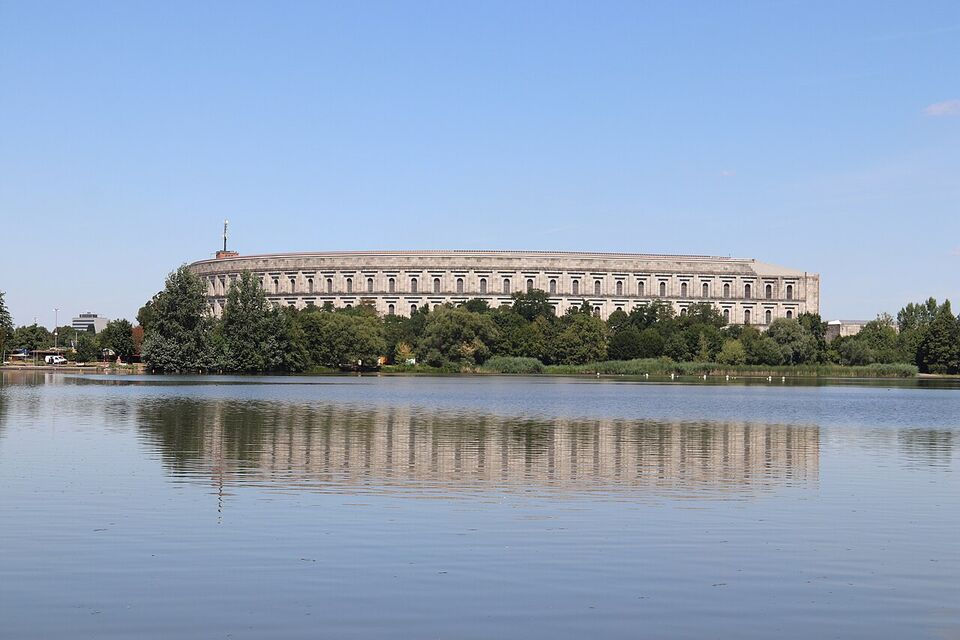
The Documentation Center (Dokumentationszentrum) is housed in the unfinished Congress Hall, a vast horseshoe-shaped building intended for 50,000 people, at Bayernstraße 110. It has been through a long renovation. The new permanent exhibition, "Nuremberg and the Nazi Party Rallies," has been open to the public since a trial operation began on May 22, 2026, and an official opening ceremony was scheduled for November 4, 2026. Parts of the center had been closed since 2020. The city's own pages describe the center as now open, though one of them still shows a teaser for a November 4 opening, so a quick check of the website before you go is sensible.
- Admission: adults €7.50 (about $8); reduced €2.50 (about $3) for ages 4 to 18 and students; a small-group card for one adult with up to three children is €8 (about $9). A Media-Guide audio guide of about 90 minutes in 9 languages is included. Online tickets carry a 10 percent service fee.
- Hours: Monday to Friday 9 a.m. to 6 p.m.; Saturday and Sunday 10 a.m. to 6 p.m.
- Tours: public tours in English were listed for Sunday at 1:30 p.m. (1 hour, €5, about $6, plus admission) from July to early November 2026. Check whether the program continues into winter.
- Getting there: trams 6 and 8 stop at Doku-Zentrum, directly in front of the entrance (some sections have replacement buses because of construction). Tram 7 or 10 and the S2 S-Bahn stop at Dutzendteich, near the lake and the Zeppelin Field.
- Access: step-free entrance, elevators to all main levels and an induction loop for hearing aids.
Allow 2 to 3 hours for the exhibition, plus time outdoors on the Zeppelin Field and the Great Road if the weather is dry. The grounds are not a monument, they are a place to understand how propaganda staged power. Our history guide gives the wider background.
Insider tip
Do the Documentation Center on one morning and the Memorium on another, or at least with a meal between them. Both are heavy, and a half-day each is more than most people expect. The tram ride to the Rally Grounds takes about 15 minutes from the old town.
Courtroom 600 and the Memorium
The international war crimes trial of senior Nazi leaders (the International Military Tribunal) was held in Courtroom 600 of the Nuremberg Palace of Justice from November 20, 1945 to October 1, 1946. The Allies chose Nuremberg partly because the Palace of Justice was largely undamaged and had a prison attached. Further trials of doctors, judges, industrialists and others continued in the building until 1949. The Memorium Nuremberg Trials in the same building tells that story and includes the courtroom itself.
- Admission: adults €7.50 (about $8); reduced €2.50 (about $3) for ages 4 to 18, pupils and students. The price includes a 10 percent online service fee, and tickets cannot be refunded or exchanged. A day ticket for €4 more covers other municipal museums on the same day.
- Hours: from November 1, 2026 to March 31, 2027, Wednesday to Monday 10 a.m. to 6 p.m. (arrive by 5:45 p.m.); closed Tuesdays. Closed December 24 and 25, 2026; open December 26 and 31.
- Is the courtroom accessible? Yes, as part of the exhibition, but it is closed on certain event days, and a media installation that shows the room as it looked in 1945-46 may not run on some days. Recent closures included October 7-9, 2026 (for an international forum), and the museum listed no dates for 2027. Check the closing-times page before your visit.
- Tours and guides: a public guided tour is offered on Saturdays, and a media guide is available through the free museum app.
Germanisches Nationalmuseum
The Germanisches Nationalmuseum (GNM), near the Kornmarkt, is the largest museum of German art and culture, with collections from prehistory to the present. Highlights include works by Dürer and other Renaissance painters, the Behaim globe (the oldest surviving terrestrial globe, from 1492), musical instruments and toys. Plan two hours for a selection or half a day for more. We could not load its site to confirm the current admission price or hours, so check them online before you go.
Bratwurst, Rotbier and other food
Nuremberg's Rostbratwurst is a small grilled pork sausage, about the size of a finger, with a protected status in the European Union. You order by the number, typically 6, 8, 10 or 12, served on a pewter plate with sauerkraut or potato salad, or in a roll as a Drei im Weckla (three in a bun) to eat on the street. A plate of 6 to 8 sausages is a normal lunch.
- Rotbier: a regional red-brown lager, malty and smooth, available in the city's pubs and breweries. See our drinks guide for more on beer styles.
- Lebkuchen: a soft spiced gingerbread, often with almonds and a wafer base. Nuremberg's version is protected too. Sold in packaged tins at the market and shops.
- Franconian dishes: roast pork with dumplings, Schäufele (a roasted pork shoulder), and carp in autumn. Our food guide explains menus and tipping.
Restaurants in the old town range from simple sausage kitchens to beer halls. We do not list individual places, because hours change; pick one with a menu in German on the board, a short list and a table of local customers.
Christkindlesmarkt
The Nuremberg Christkindlesmarkt is one of the oldest and best-known Christmas markets in Germany. In 2026 it runs from Friday, November 27 to Thursday, December 24, on the Hauptmarkt. It is open daily 10 a.m. to 9 p.m., and on December 24 until 2 p.m. On the opening night, a young woman playing the "Christkind" (Christ child) recites a prologue from the Frauenkirche balcony, and the market pauses from 5:30 p.m. to 6 p.m. for the ceremony. It stays open until 10 p.m. on that Friday for the "Long Night" of the Christkindlesmarkt, according to the city's page. The current Christkind is Nora Falk, chosen for a two-year term.
Alongside the main market are a children's Christmas (Kinderweihnacht) on Hans-Sachs-Platz (November 27 to December 30), a Market of the Partner Cities (to December 23), the Star House (Sternenhaus, from November 28) and a winter village with a Ferris wheel on Jakobsplatz from November 13, 2026 to January 9, 2027. Mugs for mulled wine (Glühwein) carry a deposit (Pfand) of a few euros, refunded when you return the mug. The city has barriers and police around the market and does random bag checks, so bring a small bag. Pickpockets work crowds, so keep valuables in a zipped inside pocket.
Watch out
Weekend evenings in December are very crowded, and hotels in the old town are full by early autumn for those dates. Weekday afternoons are easier. See the Christmas markets guide for how Nuremberg compares with other cities.
Bamberg day trip
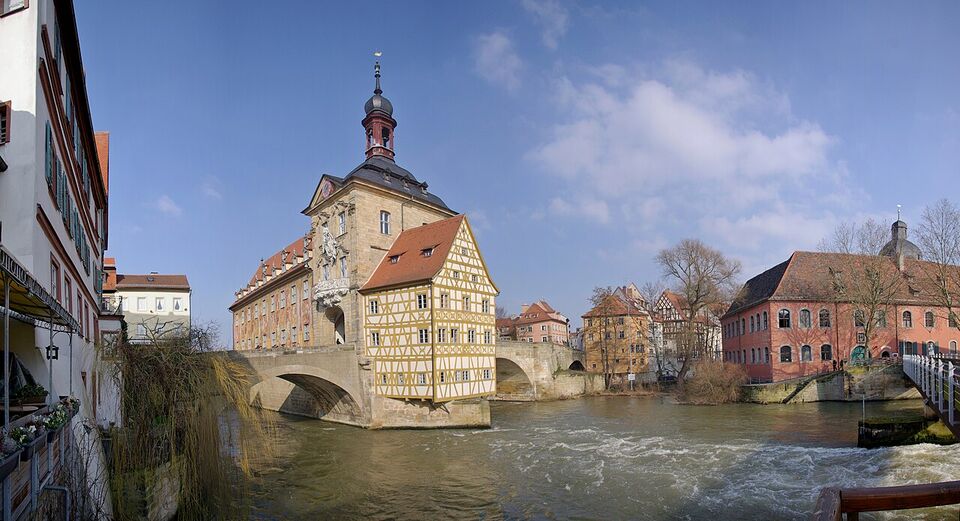
Bamberg is about 38 miles (62 km) north of Nuremberg, with regional and fast trains taking 40 to 50 minutes. Its old town is a UNESCO World Heritage site, spread over seven hills. Highlights include the cathedral, the New Residence (adults €7, about $8, per the 2026 Bavarian price list), the old town hall built on an island in the river and the "Little Venice" row of fishermen's houses.
The city is best known for Rauchbier, a smoked beer that tastes of bacon and campfire. The tavern Schlenkerla serves it from oak casks at Dominikanerstraße 6. It is open daily, 9:30 a.m. to 11:30 p.m. with food from 11 a.m. to 10 p.m. (its beer garden opens from Easter to October). The smoke taste surprises most first-timers; order a small one with a meal. More day trip ideas are in our day trips guide.
Getting there and around
Nuremberg's main station (Hauptbahnhof) sits at the south edge of the old town, a 5-minute walk to the first sights. Fast ICE trains from Munich take about an hour, from Frankfurt about 2 hours 10 minutes and from Würzburg about an hour. A Berlin trip takes about 4 to 4.5 hours. The airport is on the U2 subway line, about 12 to 15 minutes from the main station. A rebuilt rail line between Nuremberg and Regensburg reopened after a closure that ended on July 31, 2026. Our train tickets guide explains fares and how to save, and Munich is the natural neighbor.
The old town is walkable; use trams, buses or the U-Bahn for the Rally Grounds and the Memorium. The Nürnberg Card costs about €38 (about $43) for 48 hours and includes free public transport in the city zone and entry to many museums, though the city's page showed a graphic that may be from an earlier year, so confirm the price. It pays off if you visit three or four museums. A single-day plan for the Dürer House, the castle and the Memorium usually costs less with individual tickets.
Save money
If you plan the Dürer House, Memorium and Documentation Center in one day, compare the €4 municipal-museum day ticket (add-on to the first ticket) with the Nürnberg Card. The museums' pages say the add-on gives same-day entry to the other municipal museums, which should make it much cheaper than three full tickets; confirm at the first ticket desk.
Add it to a route in the trip builder, or ask us to plan the hotels, trains and guides for you.