Overview
The Rhine and Moselle are the part of Germany where river, castles and vineyards come together in a few hours of travel. The most famous stretch is the Upper Middle Rhine Valley, a UNESCO World Heritage Site (since 2002) between Bingen and Koblenz. Here the river runs through a narrow gorge about 40 miles (65 km) long, with some 40 castles and ruins on the slopes above terraced vineyards.
The easy way to do it is to base yourself in one village, ride a boat for part of the gorge, and use the trains for the rest. The Moselle, a tributary that joins the Rhine at Koblenz, is quieter. It has wine villages like Cochem and Bernkastel-Kues, Burg Eltz in the hills above the valley, and Roman Trier at its upper end.
This guide works as a planner for both rivers. It covers the gorge from Bingen to Koblenz, how boats, trains and ferries fit together, the Moselle towns, Burg Eltz, wine tasting, where to sleep and what changes by season. For the big Rhine cities at each end, see our guides to Frankfurt and Cologne.
Watch out
The Rhine is very low this autumn. On November 6, 2026 the Kaub gauge, the benchmark for the gorge, read about 22 cm after a record low of under 20 cm in August. Low water can cut boat services and reroute river cruises, so check KD's news page before you buy a ticket.
How to Plan Your Days
The gorge is compact. From Rüdesheim and Bingen to Koblenz is roughly 40 miles (65 km), and almost every castle you came to see sits within the first two-thirds of it. That makes it one of the easiest places in Germany to design around a single night or two.
- One day from Frankfurt: train to Rüdesheim, boat to St. Goar, lunch, train back. It is tiring but works well in summer.
- Two days: sleep in Bacharach, Oberwesel or St. Goar. Day one is boat, castles and a vineyard walk; day two is Boppard, the Marksburg and Koblenz.
- Four days: add Cochem, Burg Eltz and a wine village such as Bernkastel-Kues, or a day in Trier.
We suggest sleeping in the gorge rather than in a big city: the villages empty out after the last day boats, and the evening light on the castles is half the point. If your flight lands in Frankfurt, see our flights guide for the airport train, then continue by regional train as described below.
Getting Around: Boats, Trains and Ferries
KD boats
The Köln-Düsseldorfer company (KD) runs the large sightseeing boats on the Rhine, plus smaller operators on short hops. Boats stop at the villages on both banks, but not all stop at every pier, and timetables change from year to year. The 2026 season ran from March 28 to October 25, with a high season of April 25 to October 4. The 2027 timetable had not been published as of November 2026, so treat Easter to October as the likely window and check k-d.com.
| Route (2026 adult fares) | Single | Return |
|---|---|---|
| Rüdesheim or Bingen to St. Goar | €28 (about $31) | €31 (about $35) |
| Rüdesheim to Koblenz | €62 (about $69) | €67 (about $75) |
| Mainz to Cologne | €67 (about $75) | €72 (about $81) |
The direction matters. Going downstream (north) from Rüdesheim to St. Goarshausen takes about 1 hr 40 min on KD's winter timetable; the same stretch upstream takes about 3 hours. That is why we suggest taking the boat downstream and the train back. Fares for 2027 may differ, so check before booking.
A short Loreley round trip from Boppard or Rüdesheim ran daily from April 25 to October 4 in 2026 and is the best choice if you only want an hour or two on the water. In winter, KD lists a reduced Loreley service between Rüdesheim and St. Goarshausen (with stops at Bingen, Kaub and St. Goar) from October 19, 2026 to April 2, 2027, but only if enough passengers book. Call or email KD to confirm it is running.
Trains on both banks
A railway runs on each side of the river, and both are busy freight lines. The left bank (west) line connects Cologne, Koblenz, Boppard, St. Goar, Oberwesel, Bacharach, Bingen and Mainz. The right bank (east) line connects Koblenz, Kaub, Assmannshausen, Rüdesheim and Wiesbaden. Regional trains (RB and RE) cover both, and a Deutschlandticket (€63 a month in 2026, about $71; €66.80 from January 2027, about $75) pays for them, though not for ICE or boats. Our train tickets guide explains whether a monthly ticket beats single tickets for a short trip.
Watch out
The right-bank line (Troisdorf to Wiesbaden) is closed for a full rebuild from July 10 to December 12, 2026, with replacement buses. If you travel before December 13, use the left-bank trains and the ferries, and check bahn.de or DB Navigator for the day. The Rüdesheim tourist office also warns that the closure runs to December 12.
Freight trains pass every few minutes day and night. If you are a light sleeper, ask for a room on the side away from the tracks.
Ferries and no bridges
There is no bridge across the Rhine in the gorge: the next crossings are at Mainz and Wiesbaden upstream and at Koblenz downstream. Small car and foot-passenger ferries fill the gap. The main crossings are Bingen to Rüdesheim, St. Goar to St. Goarshausen, Oberwesel to Kaub, Boppard to Filsen and Niederheimbach to Lorch. They run at fixed times in the daytime, and the smaller ones stop in winter. Foot-passenger fares are a few euros; confirm the current fare and schedule on the ferry operator's page or at the pier.
These ferries are how you turn a one-bank walk into a loop: arrive by train on the left bank, ferry to the right, walk or take a boat, and return.
Driving
Roads run along both banks, but the villages have narrow streets and limited parking. A car makes sense only for the Moselle hills and Burg Eltz. If you do rent one, our driving guide covers parking discs, environmental zones and the rules that catch visitors out.
The Rhine Gorge, Town by Town
These are the stops we would plan around, in the order you meet them going downstream from Rüdesheim and Bingen.
Rüdesheim and the Drosselgasse
Rüdesheim is the busiest wine town on the Rhine, famous for the Drosselgasse, a narrow lane of wine taverns about 500 ft (150 m) long. It is touristy but lively, and it is the easiest base if you arrive from Frankfurt. The Niederwald monument above the town is reached by cable car or on foot, and the Christmas Market of Nations runs November 19 to December 23, 2026.
Bingen
Bingen sits at the mouth of the Nahe and is the boat and ferry gateway to Rüdesheim. It is a good place to change between train, boat and ferry, but most visitors stay on the Rüdesheim side.
Bacharach
Bacharach is a compact walled town with half-timbered houses, Burg Stahleck above it and vineyards behind. It is one of the best places to sleep in the gorge because it is small enough to explore in an evening.
Kaub and Pfalzgrafenstein
The Pfalzgrafenstein, a small toll castle on an island in mid-river, was used to collect fees from passing boats in the Middle Ages. Kaub is also where the water-level gauge is read that decides whether big ships can pass the gorge.
Oberwesel
Oberwesel keeps long stretches of its medieval town wall and towers. It is quieter than Bacharach and a good alternative if the larger towns are full.
St. Goar and Burg Rheinfels
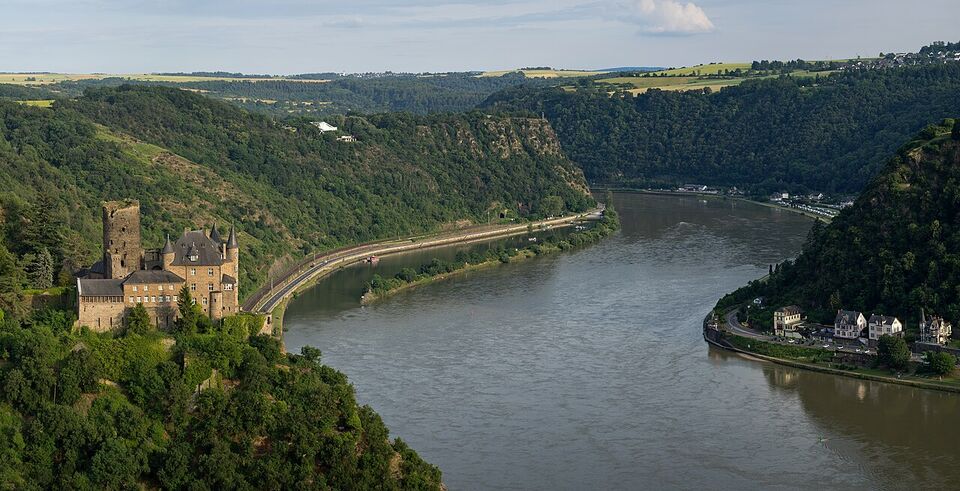
Above St. Goar stand the ruins of Burg Rheinfels, the largest castle ruin on the Middle Rhine, with tunnels you can walk through (bring a flashlight or phone). Directly across the river, St. Goarshausen has the Loreley path.
The Loreley
The Loreley is a slate rock that rises about 433 ft (132 m) above the river at the narrowest and deepest part of the gorge. In the legend, a siren on the cliff lured sailors to their deaths. You see it from the boat, or hike up from St. Goarshausen.
Boppard
Boppard has a Roman fort wall, a long riverfront promenade and a viewpoint over a big bend of the Rhine (the "Vierseenblick"). It is a good lunch stop between St. Goar and Koblenz.
Marksburg
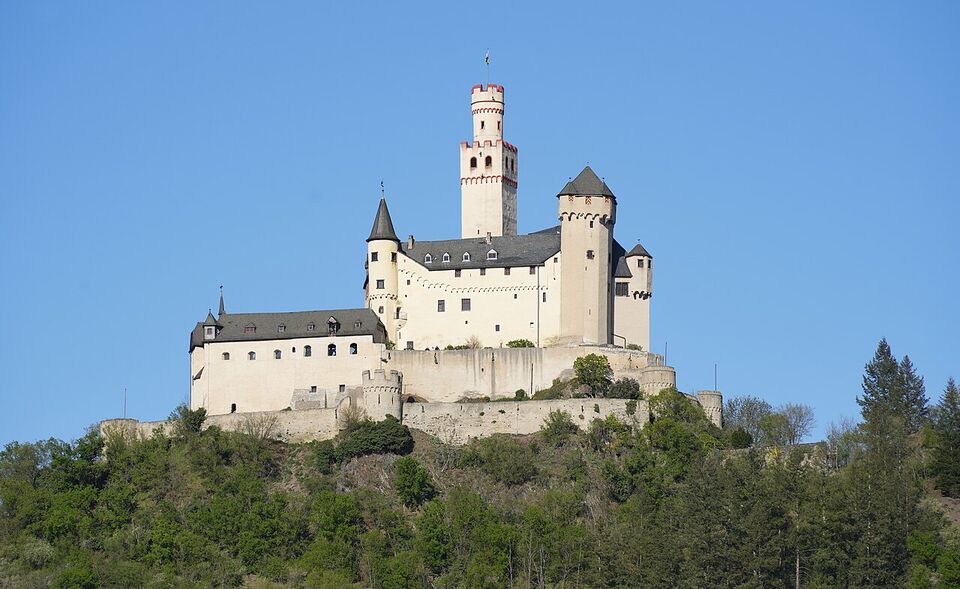
The Marksburg is the only hilltop castle on the Middle Rhine that was never destroyed, and you can only enter on a guided tour.
Two more details help with planning. English tours at the Marksburg run daily in summer at 11 a.m., 1 p.m. and 4 p.m., and on weekends in winter at 1:30 p.m. (the times can change at short notice). Tickets in 2026 were €12 for adults (about $13) and €24 for a family (about $27); summer hours run from March 21 to November 1 and winter hours are 11 a.m. to 4 p.m. daily, closed December 24 and 25.
Rüdesheim: Wine and Cable Cars
Rüdesheim is part of the Rheingau wine region, and it is where most people eat and drink. The Drosselgasse is crowded and loud, with live music in the taverns in the evenings, so decide whether that is what you want. Quieter wine bars sit in the lanes on either side.
The Niederwald monument, a large statue of Germania built in the 1880s to mark German unification, is the standard excursion. You can walk up through the vineyards in roughly an hour, or take the cable car; the chairlift to Assmannshausen was out of service with a technical fault when the town's tourist site was last updated, so check before you plan a one-way walk to Assmannshausen. Some visitors combine the cable car and a boat on one ticket, and the town's site lists Rheinstein Castle in a bundle.
For other Rhine wine regions and what to drink, our beer and wine guide goes deeper.
The Moselle Valley
The Moselle (Mosel in German) flows in tight loops between steep slate hillsides covered in vineyards, mostly Riesling. The best-known stretch runs from Koblenz to Trier, about 120 miles (190 km) by river, and trains run along most of it. The towns are small, and almost everything is within a ten-minute walk of the station or the river.
Cochem
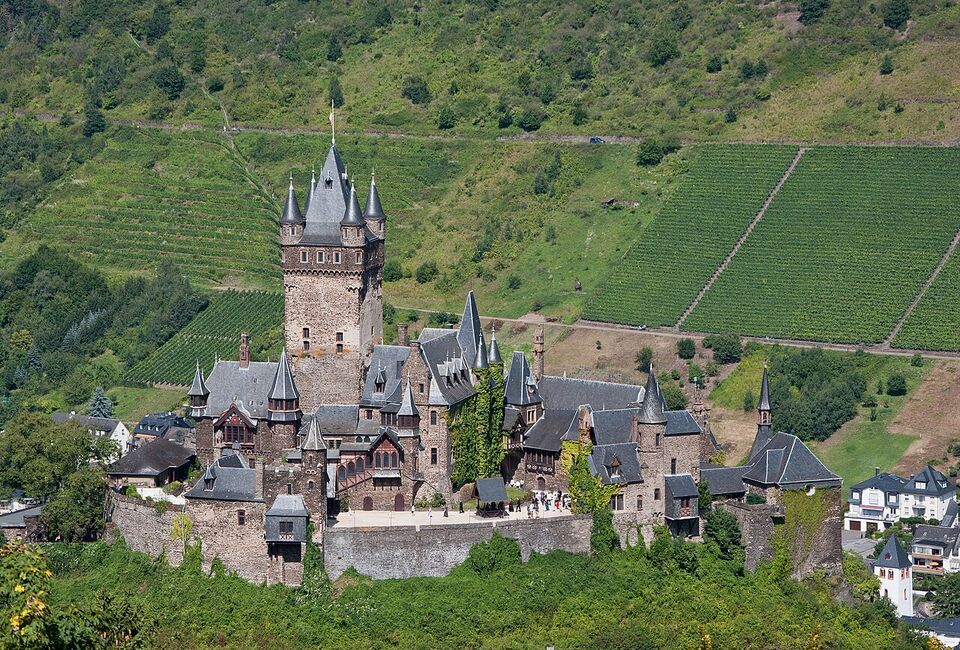
Cochem is the easiest base on the Moselle. Its Reichsburg castle is a 19th-century reconstruction of a medieval fortress, with a lively riverfront and a market square below. Regional trains connect it to Koblenz in under an hour, and it has the most hotels and restaurants of the small towns. It is also the best base for Burg Eltz.
Beilstein and the small villages
Beilstein, a few miles upriver from Cochem, is a tiny village with a ruined castle, steep lanes and a small number of guesthouses. It has no station, so reach it by boat from Cochem in season or by bus or car. It is a good choice for a quiet night rather than a day of sightseeing.
Bernkastel-Kues
Bernkastel-Kues is the wine capital of the middle Moselle, with a market square of half-timbered houses and the ruin of Burg Landshut above the town. A bridge joins the two halves of the town, Bernkastel on the right bank and Kues on the left. It does not have a main-line station, so you reach it by bus from Wittlich or by car; plan extra time for the connection.
Trier
Trier is Germany's oldest city, founded by the Romans in 16 BC, and has several UNESCO-listed Roman monuments. The Porta Nigra, a Roman city gate, is the symbol. In 2026 it cost €6 for adults (about $7), with reduced and family rates, and opened 9 a.m. to 4 p.m. from November to February, 9 a.m. to 5 p.m. in March and October, and 9 a.m. to 6 p.m. from April to September (last entry 30 minutes before closing). It is closed December 24 to 26, December 31, January 1 and Rosenmontag.
The city's Antikencard bundles the four Roman monuments (the Porta Nigra, Kaiserthermen, Amphitheater and Thermen am Viehmarkt) and the Rheinisches Landesmuseum. The Basic card, which covers two monuments and the museum, is €18 (about $20); the Premium card for all four monuments and the museum is €28 (about $31). Each card also covers one adult plus up to four children under 18. Trier is about two hours from Koblenz by regional train, so it works as a long day trip or, better, an overnight.
Burg Eltz
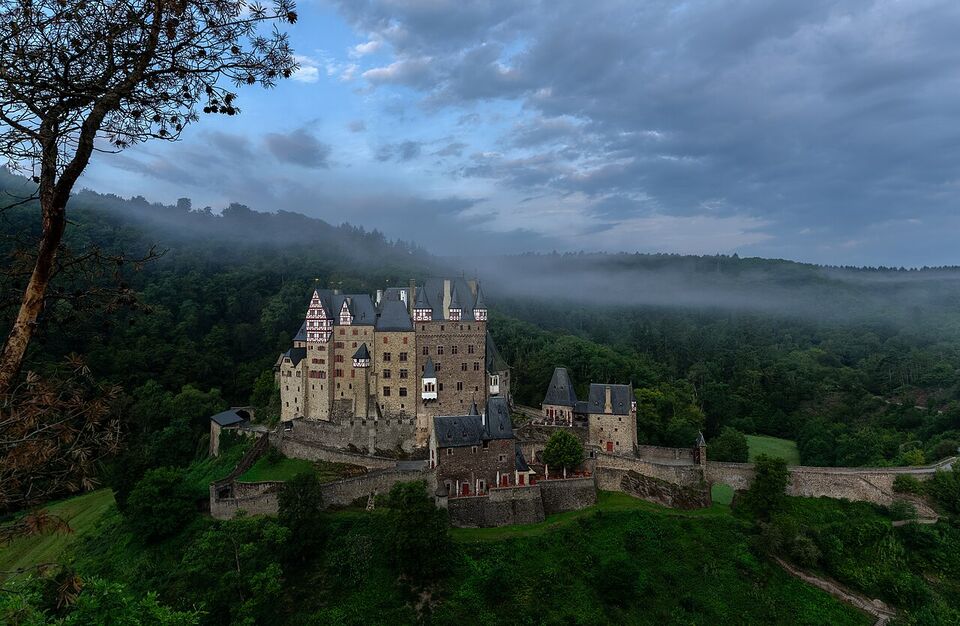
Burg Eltz stands on a rock in a side valley of the Moselle, about 20 miles (30 km) from Koblenz as the crow flies, and has belonged to the same family for roughly 850 years. It is a compact, towered castle that looks like an illustration from a fairy tale, and the interior is decorated and furnished in a way few castles are. We recommend it for first-time visitors who want one castle interior and have time for the walk.
| Item | Price | Notes |
|---|---|---|
| Adult ticket | €14 (about $16) | Includes the guided tour and the treasury |
| Family (2 adults, children under 18) | €34 (about $38) | |
| Students and visitors with disabilities | €7 (about $8) | Proof needed |
| Children up to 6 | Free | |
| Shuttle from the castle car parks | €2 (about $2) each way | Cash only, every 10 minutes |
| Parking, all day | €4 (about $4.50) | Cash only |
The castle is open daily from 9:30 a.m. in season. The 2026 season ended on November 1; it is closed from November 2, 2026 through March 20, 2027, and the 2027 season starts on March 21. The guided tour lasts about 35 to 40 minutes and runs in German, English and French, and a free printed guide is available in many other languages. Last admission is around 5 p.m., but the castle's own pages give two different closing times, so arrive by mid-afternoon.
The castle's own advice is to plan 2.5 to 3 hours from the car park. The two standard approaches are:
- Walk from Moselkern station. The path from Moselkern or the Ringelsteiner Mühle is about 1.5 miles (2.5 km) and takes 35 to 45 minutes. Moselkern is on the Koblenz to Trier line.
- Drive or taxi to the car parks near Wierschem. Park and take the shuttle bus (€2, about $2, per journey), or walk down. Bring coins: parking and the shuttle are cash only.
Insider tip
Go on a weekday morning, as early as you can. Burg Eltz is small, and tours fill in the middle of the day in summer. The exhibits inside are labeled in German, so pick up the English flyer at the entrance.
Wine Tasting
Riesling dominates both valleys. On the Rhine, the Rheingau (around Rüdesheim) and the Middle Rhine make crisp, mineral wines; on the Moselle, light, lower-alcohol Rieslings with a range from dry (trocken) to sweet. Look for the word Weingut (winery) or Straußwirtschaft (a seasonal farm tavern, open when a branch is hung up).
- Tasting rooms: Many wineries offer a tasting of several wines for a modest fee, often credited if you buy. Ask before you pour, and prices vary widely.
- Wine bars in the towns: Easier if you have no car or appointment. A small glass (usually 0.2 l) is the norm.
- Driving: The legal limit is 0.5 per mille, with zero tolerance for drivers under 21 or in their first two years. Do not drive between tastings; use a train, bus or taxi.
- Shipping wine home: Check US import rules before you buy cases. A few bottles in a checked bag is simpler.
Our drinks guide explains Federweißer (the cloudy new wine of early autumn), Sekt and the other terms you will see.
Different from home
German wine labels show the grape and the village or vineyard, not a brand. A bottle labeled Riesling Kabinett feinherb is a Riesling picked ripe and made off-dry. Ask the server which wines are dry; many American drinkers expect "Riesling" to mean sweet.
Where to Stay
We suggest choosing the base first, then the hotel.
| Base | Good for | Typical price |
|---|---|---|
| Rüdesheim | First-timers, trains from Frankfurt, wine taverns | $$ |
| Bacharach | Quiet evenings, a small walled town | $ to $$ |
| St. Goar or Oberwesel | Castle walks, left-bank trains | $ to $$ |
| Boppard | Larger town, more restaurants | $ to $$ |
| Koblenz | Rail hub for the Rhine and the Moselle | $ to $$ |
| Cochem | Moselle base and Burg Eltz | $ to $$ |
| Trier | Roman sites and nightlife | $ to $$ |
The tiers are guidelines for a double room (under $120 for $, $120 to $300 for $$). Prices rise in July and August, and in autumn during the harvest weekends. Some towns charge a small overnight tax; Trier's is 3.5% of the net room price. See our where to stay guide for taxes, breakfast and how to book. Many small hotels in the gorge close from December to March, so check before you plan a winter trip.
Seasons and When to Go
May, June, September and early October are the best months: the boats run, the castles are open, and vineyards are green or turning gold. July and August are warm and crowded. In April you often get blossom and thinner crowds, but the boats are on reduced schedules until the high season begins.
- November to March: Burg Eltz is closed, most KD sailings stop, and many small hotels close. The Marksburg stays open on winter hours, and the larger towns still have restaurants and trains.
- Christmas season: The Rüdesheim Christmas Market of Nations runs November 19 to December 23, 2026; Trier and Cologne have markets from late November. See our Christmas markets guide.
- Rhine in Flames 2027: Bingen and Rüdesheim on July 3, Spay and Koblenz on August 14, Oberwesel on September 11, and St. Goar and St. Goarshausen on September 18. Fireworks and illuminated castles are the draw, and rooms sell out well ahead.
Our when to go guide compares the months across the country.
Sample Plans
- Day 1
Rüdesheim to St. Goar
Arrive in Rüdesheim by train from Frankfurt (see our getting around guide for the right ticket). Walk up to the Niederwald monument, take a downstream KD boat to St. Goar, climb to Burg Rheinfels and sleep in St. Goar or Oberwesel.
- Day 2
Loreley, Boppard and Marksburg
Cross to St. Goarshausen and hike up to the Loreley viewpoint, then take the train to Boppard for lunch. Continue to Koblenz or Braubach for the Marksburg tour.
- Day 3
Cochem and Burg Eltz
Train from Koblenz to Cochem or Moselkern and walk to Burg Eltz in season. Return to Cochem for a wine bar and the evening on the river.
- Day 4
Trier or Bernkastel
Take a regional train to Trier for the Porta Nigra and the Roman monuments, or use the day for wine villages by bus or car. Return to Koblenz or head on to Luxembourg or Frankfurt.
If you are building a longer route, our castles guide shows how the Rhine fits with Heidelberg, Neuschwanstein and the Wartburg, and our river cruises guide covers multi-day ships that sail the same waters.
Save money
Buy a one-way boat ticket and ride the train back. A single KD ticket from Rüdesheim to St. Goar is €28 (about $31) against €31 (about $35) return, but the train home costs far less than an upstream boat's 3-hour ride. Trains are covered by a Deutschlandticket on regional lines, and the left-bank trains run roughly hourly.
Practical Tips
- Carry some cash. Parking and shuttles at Burg Eltz are cash only, and small wine taverns and ferries may not take foreign cards.
- Check the right-bank rail closure (to December 12, 2026) and KD's news page for low-water notices.
- Wear shoes with grip. Castle paths, vineyard steps and Burg Rheinfels' tunnels are uneven.
- Book guided tours (Marksburg) in the first slots of the day in high season.
- Shops close on Sundays, and many small restaurants close one or two days a week outside summer.
Add it to a route in the trip builder, or ask us to plan the hotels, trains and guides for you.