Overview: what really differs from home
German manners are less about warmth than about order, clarity and respect for shared space. Americans are rarely in trouble for getting the details wrong, but a handful of habits will smooth almost every encounter: greet people when you walk into a small shop or waiting room, keep your voice down on trains, follow the recycling signs, and do not cross a street against a red light when children are watching.
Directness is normal. A German who says "That does not work" or "No, thank you" is not being unfriendly, and service staff do not usually perform cheerfulness. In return, Germans expect you to be equally plain: say what you want, say thank you, and do not take a curt answer personally.
This page gives short do and don't lists for the situations visitors meet most. For restaurant mechanics and tipping details, also see German food and Money in Germany. For words to use, see Useful German phrases.
Greetings, Sie and du, and titles
Germans shake hands on meeting in formal and business settings, with a brief firm grip and eye contact. Among friends and family, hugs and cheek kisses are more common, and in small Bavarian or Baltic shops a spoken greeting is enough. When in doubt, wait to see whether the other person offers a hand.
The bigger adjustment is Sie (formal "you") versus du (informal "you"). Use Sie with adult strangers, shop staff, waiters, hotel clerks, police and anyone clearly older than you. Switch to du only after the other person suggests it, usually with "Wir können uns duzen." Children, teenagers and close friends use du. Many younger Germans, hostel staff, bar staff and hikers in the Alps use du with everyone, and you can follow their lead, but never start with du to someone older.
- Do: say Guten Morgen, Guten Tag or Guten Abend when you enter a small shop, bakery, doctor's office or lift, and Auf Wiedersehen or Tschüss when you leave.
- Do: use Herr (Mr.) or Frau (Mrs. or Ms.) with the last name, for example "Frau Schneider." Titles matter: a person called Doktor Weber is "Herr Doktor Weber" or "Frau Doktor Weber" in formal speech.
- Do: introduce yourself with your last name in formal settings.
- Don't: use first names with strangers, or call a woman Fräulein, which sounds old-fashioned and insulting.
- Don't: keep your hands in your pockets while talking to someone in a formal setting.
Regional greetings are covered in Useful German phrases: Grüß Gott in Bavaria, Moin in the north and Servus in the south, among others.
Punctuality and invitations
Being on time is a sign of respect. For a business meeting, a doctor's appointment, a tour or a reservation, arrive on the minute or a few minutes early. A guided tour at a castle or memorial may not let you join late, and a restaurant table may be released after 15 minutes. If you are going to be late, call or message.
Trains are a different matter. Deutsche Bahn's own figures show long-distance trains arriving on time (under 6 minutes late) between about 52 and 64 percent of the time in each month of 2026 through October, so build slack into connections (see Getting around Germany). Arrive at the platform a few minutes ahead of departure all the same, because trains leave on schedule when they are on time.
If you are invited to a German home:
- Do: arrive within about 5 to 10 minutes of the stated time, not much earlier. Arriving early can be awkward for the host.
- Do: bring a small gift: a bunch of flowers (unwrapped at the door, not red roses, which suggest romance), a good bottle of wine, or chocolates.
- Do: take off your shoes if you see a rack by the door, and accept slippers if offered.
- Don't: start eating until the host says Guten Appetit.
Quiet hours, Sundays and noise
German law and local house rules protect rest time. The best-known term is Ruhezeit, quiet time. The night quiet period (Nachtruhe) typically runs from about 10 p.m. to 6 a.m., and the exact hours depend on the city and the building's house rules (Hausordnung). Some older buildings also keep a midday quiet period, and many apartment houses post their rules in the hallway.
Sundays and public holidays are the longest quiet period. Noisy activity is discouraged all day: lawn mowing, drilling, hammering, loud music, power washing, and in many places dropping glass into bottle banks. Germans take this seriously, and neighbors do call the police. The same spirit explains why most shops are closed on Sundays (see Money in Germany).
Different from home
If you rent an apartment or holiday flat, treat 10 p.m. and all of Sunday as quiet. Keep voices low on balconies and in stairwells, do not run the washing machine late at night, and carry bottles to the glass container during the day on a weekday. Hotels have the same rules in spirit: late-night conversation in a corridor will get a knock on the door.
A few days are also treated as "quiet days" (stille Tage) in many states, such as Good Friday (March 26, 2027), the national day of mourning Volkstrauertag (November 15, 2026) and Totensonntag (November 22, 2026), when public events and dancing may be limited. Rules differ by state, so if you have a night out planned, check local listings.
Recycling, trash and Pfand
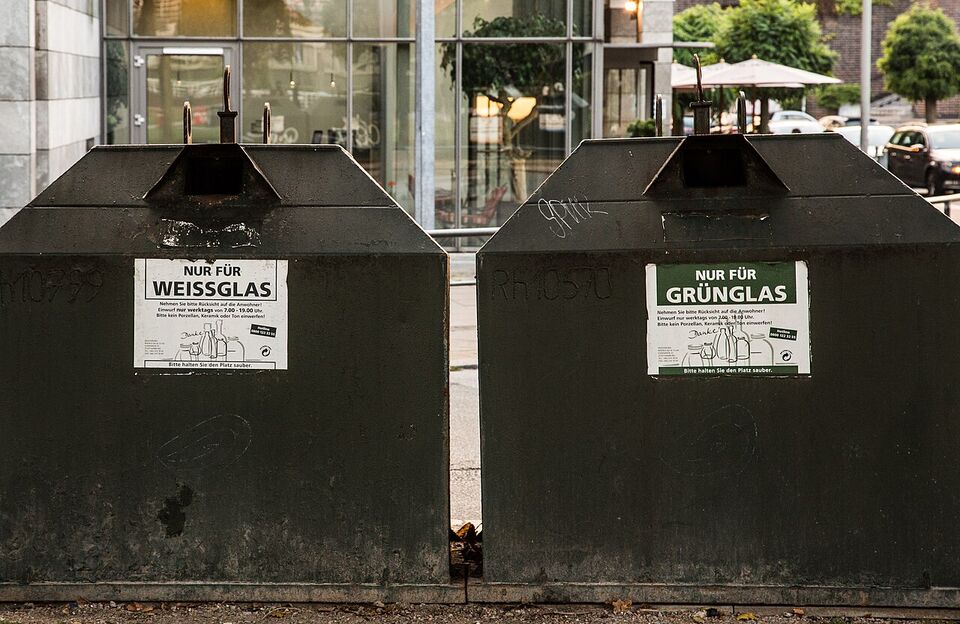
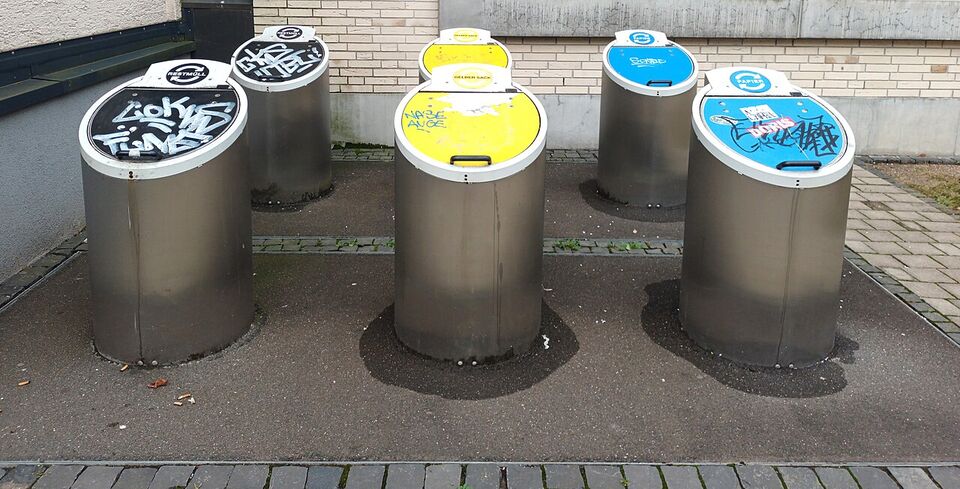
Germany sorts waste carefully, and a hotel or flat will usually have several bins. A typical set has a yellow bin or bag for plastic and metal packaging, blue for paper, brown for organic waste, black or gray for everything else (Restmüll), and separate street containers for glass by color: white, green and brown. Look at the picture on each lid, and when you are unsure, ask your host. Dropping a bottle into the wrong container or leaving bags beside a full bin draws sharp looks.
The deposit system, Pfand, is separate. Single-use (Einweg) plastic bottles and cans carry a deposit of 25 cents (about $0.28) each. Reusable (Mehrweg) bottles usually carry 15 cents (about $0.17), and many beer bottles 8 cents (about $0.09), though special swing-top bottles can cost more. Look for the words "Einwegpfand 0,25 Euro" or the DPG logo on the label.
- Do: return bottles and cans to the machine in a supermarket. Insert them one by one, then press the button for the receipt (Pfandbon), which you hand over or scan at the register.
- Do: leave empty bottles beside a public bin, rather than inside it, when you cannot return them. People who collect them will thank you.
- Don't: toss a deposit bottle in the trash if you can avoid it, and don't expect to return a bottle bought in another shop that does not stock that type.
Save money
Those 25-cent deposits add up. Buy a drink at a supermarket, then return the empty bottle at any supermarket machine before you leave the area. Christmas market mugs work the same way: you pay a deposit (Pfand) of a few euros, refunded when you return the mug to the stand (there is no single confirmed amount; each market sets its own). See Christmas markets in Germany.
Streets, bike lanes and jaywalking
Germans wait at red pedestrian signals even when no car is in sight, and children and many adults treat this as a lesson in public example. Crossing against a red light is a fineable offense; the fine for a pedestrian is small (we could not confirm the current amount, so check locally), but you will mainly attract disapproval. When in doubt, wait for the green figure (grüner Mann).
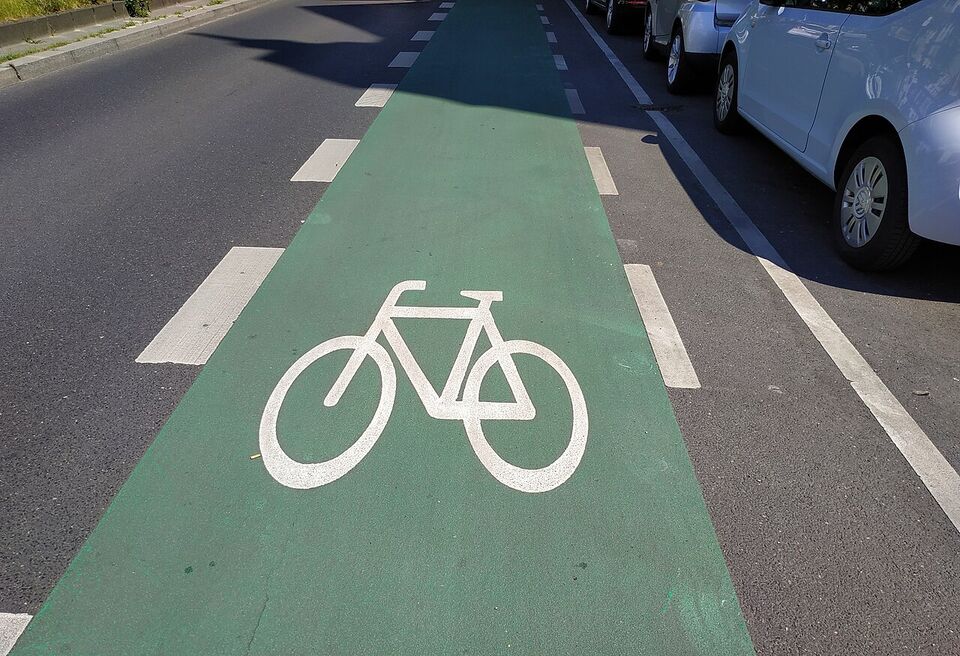
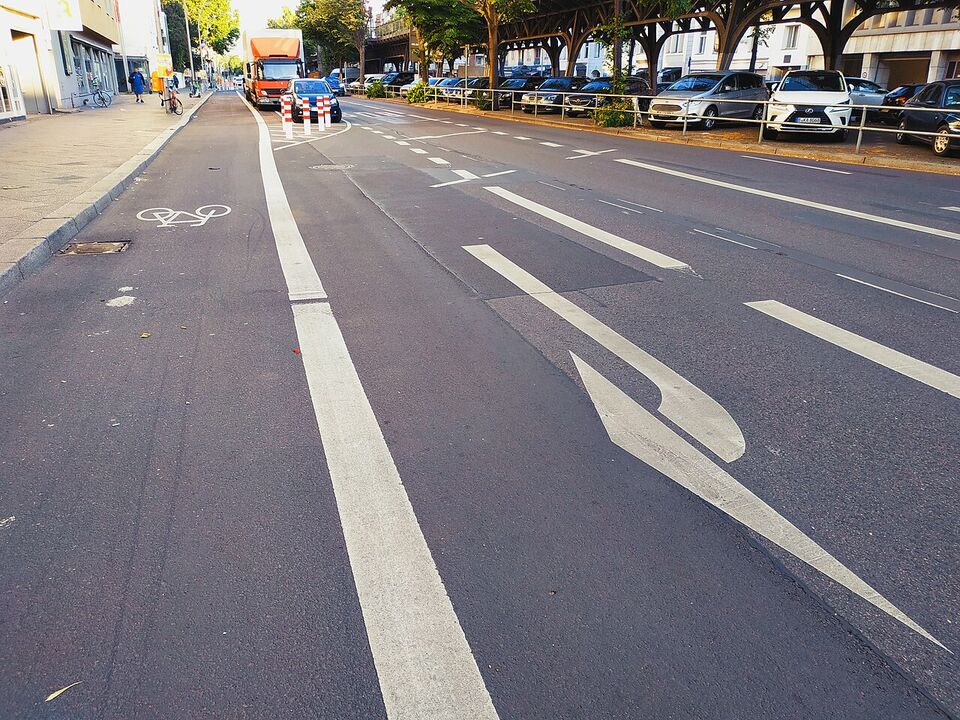
Bicycles are a serious mode of transport, and bike lanes are part of the street design. In many cities the lane is a strip of red brick or a painted band set into the sidewalk. Walking or standing in it is the fastest way to be shouted at, and cyclists can be fast. Look both ways before stepping off a curb, especially where a bike lane runs between the sidewalk and the road.
- Do: stand on the right on escalators and walk on the left.
- Do: let passengers off a train or tram before boarding.
- Don't: walk four abreast on a narrow sidewalk or cycle path.
- Don't: put your feet or shoes on train seats.
- Do: keep to the right lane on the Autobahn unless you are passing (see Driving in Germany).
On long-distance trains, the quiet compartments (Ruhebereich) are for silence: no phone calls and no loud conversation. If you have a phone call to take, step into the vestibule.
Restaurants, small talk and staring
In most restaurants, you seat yourself unless a sign says Bitte warten, Sie werden platziert ("Please wait to be seated"). Waiters will not hurry you, and the bill (die Rechnung) does not come until you ask. Say Zahlen, bitte ("The check, please"). In beer halls and traditional pubs, you may be asked to share a long table. Ask "Ist hier noch frei?" and sit down.
Splitting a bill is normal: the server asks Zusammen oder getrennt? ("Together or separate?"). Tipping follows the same principle: round up or add 5 to 10 percent. A September 2026 survey reported by The Local found that just over half of Germans tip 5 to 10 percent and about one in five tips 10 percent or more. Say the total you want to pay before the card goes through, or say Stimmt so ("keep the change") when paying cash. For more on restaurant customs, see German food.
Small talk is different from the American version. Strangers rarely chat in a line or lift, and "How are you?" is a real question, so a quick "Fine, thanks" will do. Germans tend to avoid asking what you do for a living on first meeting, or about salary and religion. Politics and history can come up, and when they do, they are discussed seriously. Americans are often heard on trains because they speak louder than the local norm. Matching the volume around you is the easiest courtesy.
Staring is also normal. You may be looked at on a train or in a cafe for several seconds without any hostility, and Germans may not return a smile. This is not rudeness. If you want to end a look, a small nod is enough.
Insider tip
Greet the room when you enter a doctor's waiting room, small shop or lift, and say goodbye when you leave. This one habit does more for how staff treat you than anything else, and it costs nothing.
Toasting and drinking
When glasses are raised, say Prost (or Zum Wohl for wine) and look each person in the eye as you clink. Clinking with everyone at the table, one at a time, is the polite way to do it. The old saying that failing to make eye contact brings bad luck is a joke, but people do notice. Do not cross arms with another person's arm while clinking, and do not drink until everyone has glasses and the first toast is done.
The legal drinking age is 16 for beer and wine and 18 for spirits, and you can drink in public in most places, though some cities limit it in certain squares. Drinking from a bottle on a train is common, but being visibly drunk is not admired. For beer styles and house customs, see Beer and wine in Germany.
Saunas, nudity and FKK
German attitudes to nudity are relaxed in two settings: saunas and designated outdoor areas. In a sauna, swimsuits are not allowed in most of the hot rooms, and you sit or lie on a large towel, not on the bare wood. Shower before you enter, take your towel into every room, and keep your voice low or silent. Many spas and baths have mixed-gender saunas by default, and some have women-only days. Staff will post the rules at the entrance. Taking a phone or camera in is strictly out of bounds.
- Do: read the sign at the door and ask staff if unsure. Rules at a thermal bath can differ between its pool area and its sauna area.
- Do: sit quietly during an Aufguss, the sauna ritual where an attendant waves hot air over guests with a towel after splashing scented water on the stones. Enter before it starts and don't leave in the middle, because opening the door lets the heat out. Don't talk.
- Don't: stare, take photos, or wear shorts or a swimsuit in a nude-only sauna.
The tradition of Freikörperkultur (FKK, "free body culture") extends to some parks and beaches. Munich's English Garden has marked areas for nude sunbathing, and the Baltic and North Sea coasts have FKK stretches of beach. Look for signs, keep a respectful distance, and don't take photos. If you do not want to see it, pick another part of the park.
Cash and everyday rules
Germany is more cash-friendly than the US. As of November 2026, businesses are not legally required to accept cards, though the finance ministry presented a plan in September 2026 to require at least one digital option from 2027. That is not yet law. Small bakeries, markets and some rural restaurants may take cash only, and a foreign debit card may be refused where a German Girocard works. Carry some euros and test your card early. Details are in Money in Germany.
- Don't: expect to shop on Sunday. Most shops are closed on Sundays and holidays, with exceptions at airports and train stations.
- Do: carry €1 or 50-cent coins for public toilets.
- Don't: take photos of strangers, especially children, without asking. German privacy culture is strict.
- Do: bring your own shopping bag. Plastic bags cost money at the register.
Nazi symbols, the salute and history
This is the most serious rule on the page. Under section 86a of the German criminal code, publicly using symbols of banned unconstitutional organizations, including the swastika, SS runes and the Hitler salute, is a crime punishable by up to three years in prison or a fine. Slogans and forms of greeting are covered too. Joking, posing for a photo, wearing a costume or doing it "ironically" is not a defense, and police act on complaints from bystanders. There are narrow exceptions for education, art and research, and they do not cover a tourist's gesture.
Watch out
Never raise an arm in a Nazi salute, mimic one, or pose with Nazi insignia, including at museums and memorial sites. Do not bring or sell Nazi-era memorabilia or literature that glorifies the regime; items with banned symbols can also be illegal to carry into or out of Germany, so ask customs if unsure. Holocaust denial is a separate crime.
At memorials and concentration camp sites, dress and behave as you would at a cemetery: speak quietly, don't eat or take smiling photos, and follow staff instructions. Guidance on visiting and what to expect is in History sites in Germany. For the practical side of staying safe and what to do if something goes wrong, see Is Germany safe?.
Add it to a route in the trip builder, or ask us to plan the hotels, trains and guides for you.