Overview: a lake with three countries
Lake Constance (the Bodensee) is the third-largest lake in central Europe, about 39 miles (63 km) long, with shores in Germany, Austria and Switzerland. There is no agreed border in the water itself. It sits at the foot of the Alps, at the southwestern edge of Germany, and it is the usual stopover between Munich and the Black Forest.
The lake rewards slow travel. Orchards and vineyards run down to the water, harbors are lined with old towns, and white passenger boats connect them in season. The main bases are Lindau (a small island town on the Bavarian end), Meersburg (a castle and wine town), and Konstanz (a university city that touches Switzerland). Nearby are Mainau, a flower island, Reichenau, an island with Romanesque churches, and Friedrichshafen, the home of the Zeppelin.
The key decision is when you go. From mid-October to late March, scheduled passenger boats are off, swimming is out, gardens are mostly closed down and fog can sit on the lake for days. From May to September, everything works. If you can only fit this region into a trip in the cold months, plan on Konstanz and Mainau's Christmas Garden rather than a boat-based trip. For where this fits in a bigger itinerary, see Germany's Destinations and Plan Your Trip to Germany.
Different from home
On the Great Lakes, the US-Canada line is marked and patrolled. On Lake Constance, the three countries never agreed where their borders run in the open water, and boats cross between them with no passport desk on board. You still need your passport in your bag, because the land borders are another matter (see below).
Getting there and getting around
Lindau is the easiest entry from the east: about 2.5 hours from Munich by direct train. Konstanz is reached from the north through the Black Forest Railway or via Stuttgart, with typical trips of three to four hours or more from Stuttgart and Frankfurt, depending on the route. From Zurich, Konstanz is about 1.5 hours by train. Friedrichshafen is a stop on the lakeside line that links Lindau and Radolfzell.
There are three ways to move along the shore: trains, boats and cars. Regional trains follow the north shore (Lindau, Friedrichshafen, Überlingen) and the Swiss shore, and they are the best way to cover distance quickly. Boats are the scenic way, and they are slow. A car helps for Meersburg and the vineyard roads. Overall, you can do the main sights without one, as long as you plan boats and trains around the timetable. For tickets, see German Train Tickets and Passes and Getting Around Germany.
A natural southern loop goes from Munich to Neuschwanstein (see Neuschwanstein Castle), then to Lindau, Meersburg or Konstanz, and on to the Black Forest and Heidelberg (see Heidelberg and the Black Forest). Füssen to Lindau is about 60 miles (95 km) by road, around 1.5 hours.
The main towns and sights
Lindau
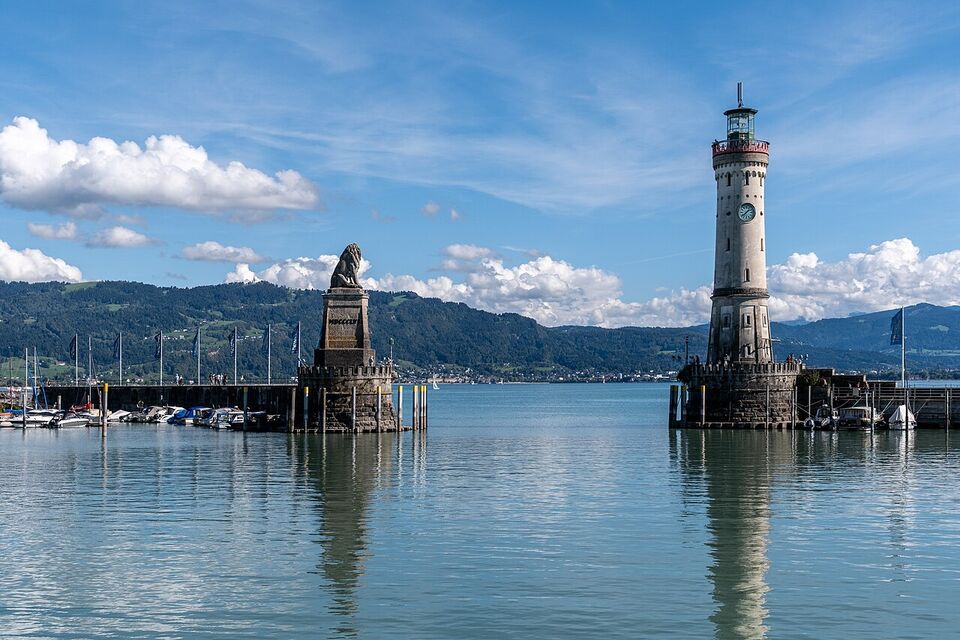
A small old town on an island connected to the mainland by a causeway and a rail bridge. The harbor entrance is guarded by a Bavarian lion statue and a lighthouse, and the old Mangturm tower stands beside it. Maximilianstraße is the main street, with painted facades and arcades. The island station is a few minutes' walk from the harbor.
Meersburg
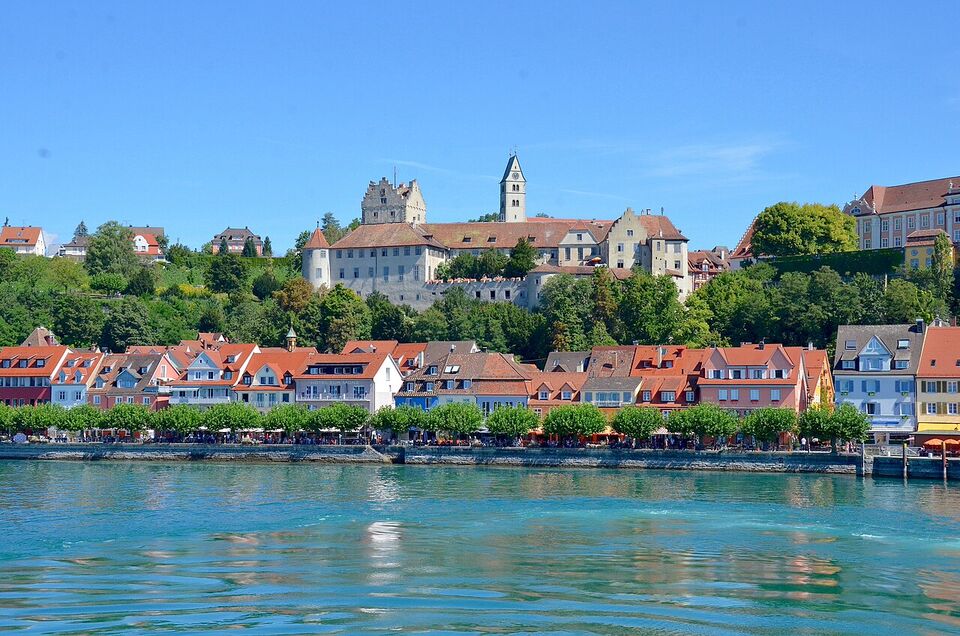
The old town is built in two layers: a lower town on the lakefront and an upper town on the hill, linked by steep lanes. Meersburg Castle is often described as the oldest inhabited castle in Germany. The surrounding slopes grow Pinot Noir (Spätburgunder) and other grapes, and you can taste local wines in the town.
Konstanz
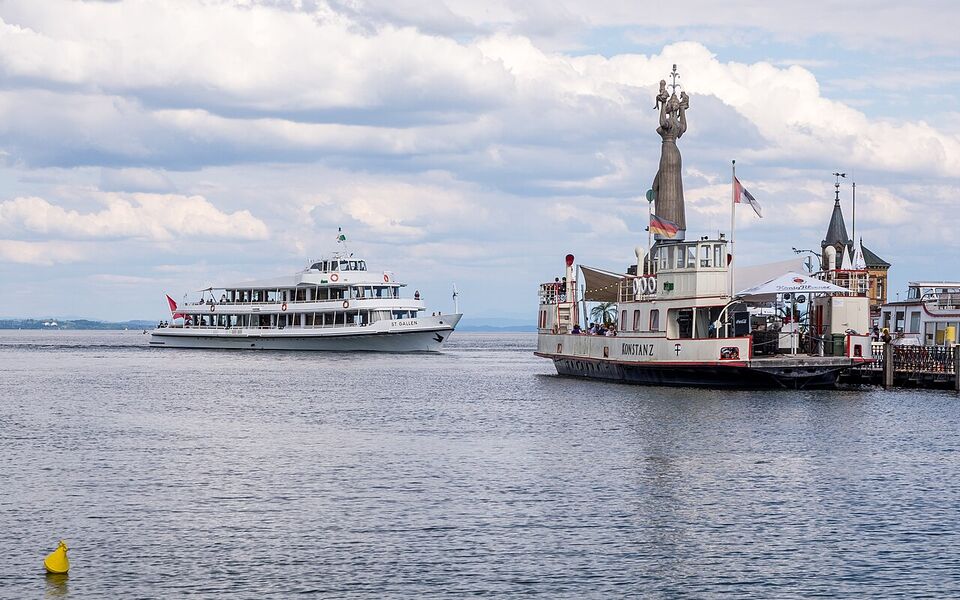
The largest city on the German shore. It hosted the Council of Constance (1414 to 1418), and its Gothic minster and old town came through World War II largely intact. The harbor has a 30-foot (9 m) statue called Imperia. Kreuzlingen, Switzerland, is on the other side of a street-level border.
Mainau
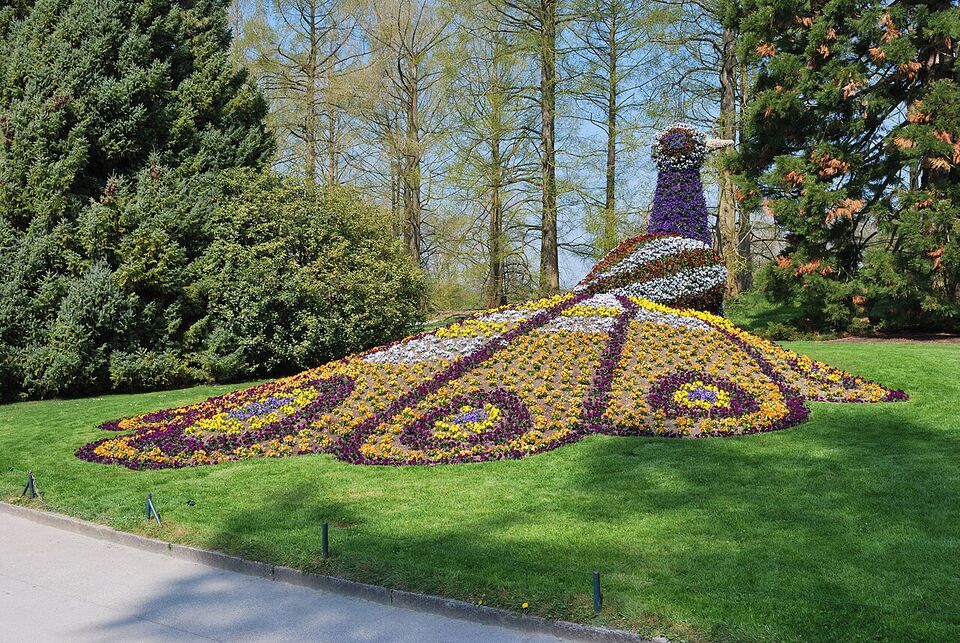
A 110-acre (45 ha) garden island north of Konstanz with a Baroque castle, tulip fields, rose gardens, a palm house and a butterfly house. The family foundation that runs it keeps it open year-round, but the flower season is spring through autumn.
Reichenau
An island linked to the mainland by a causeway, known for market-garden greenhouses and three Romanesque churches. Together, they have been a UNESCO World Heritage Site since 2000. It is a flat, quiet place for a bike ride from Konstanz.
Friedrichshafen
A working port and industrial town, rebuilt after World War II, and the home of the Zeppelin story. The Zeppelin Museum is on the waterfront, and modern Zeppelin NT airships still fly passengers from the town's airfield.
Lindau in detail
Lindau's old town occupies the whole island, and it is easy to see on foot. Start at the harbor, where a marble statue of a Bavarian lion stands on one side of the entrance and a lighthouse on the other. The statue was put up in the 1850s, and the lighthouse has a viewing platform that opens seasonally (check Lindau's tourism site for hours). On the nearby quay you can watch boats come and go from Austria and Switzerland.
Walk Maximilianstraße for the arcades and facades, then climb to the Peterskirche or the town hall for painted details. Evenings are quiet, with lamplit harbor cafes. Lindau is part of Bavaria, so it follows Bavarian shop hours (see Money in Germany for Sunday closings).
The Bregenz boat from Lindau takes about 22 minutes on the fastest 2026 sailings, which makes Austria an easy half-day side trip (see below).
Meersburg and Konstanz
Meersburg
Meersburg Castle (Burg Meersburg) is a medieval fortress, said to go back to the 7th century. The castle is open daily, usually from 10 a.m. to 6:30 p.m. in the main season and 10 a.m. to 6 p.m. in winter (November to March, from the end of the autumn school holidays), with last entry 30 minutes before closing. An adult ticket is €12.80 (about $14). Students aged 14 to 18 pay €10 (about $11), children 6 to 13 pay €8 (about $9), and reduced fees are €11.50 (about $13). Holiday hours are shorter: December 24 from 10 a.m. to 1 p.m., December 25 from 1 p.m. to 6 p.m., December 31 from 10 a.m. to 5 p.m., and January 1 from 1 p.m. to 6 p.m. No advance booking is needed.
The lower town is on the lake, where the ferry and the boats dock. The upper town is up the steps. You can reach both on foot, and a day is enough to walk, taste wine and see the castle. A day trip works from Konstanz by car ferry (about 15 minutes) or boat (about 30 minutes).
Konstanz
Konstanz is the best city base on the lake: it has a station, a harbor, a university, restaurants and nightlife, and it is connected to Switzerland on foot. The old town is small, with the minster, the Rheintorturm and the harbor with its Imperia statue. The Council of Constance, the church council that ended the Western Schism, met here from 1414 to 1418, and it also condemned the reformer Jan Hus, who was burned at the stake in 1415.
Konstanz and Kreuzlingen form a single built-up area, and you can walk across in 10 to 15 minutes. Switzerland uses Swiss francs, not euros, and prices are higher, though many shops near the border will take euros at a weaker rate. Do not forget your passport. For more on trains and buses to neighboring countries, see Germany and Its Neighbors.
Mainau, the flower island
Mainau is a garden island about 4 miles (7 km) from the center of Konstanz, linked to the shore by a short bridge. It has a long season of changing displays: spring bulbs (tulips, daffodils and hyacinths), then rhododendrons and roses in early summer, dahlias and other late-season plantings into autumn, plus a palm house, a butterfly house and a Baroque castle that you can see from the outside. The 2026 flower season ran from March 21 to October 18, so any visit in the cold months is a different experience.
Admission was listed at €26.90 (about $30) for an adult in a third-party listing, with reduced fees for seniors, students and young visitors, and free entry for children up to and including 12. Mainau updates prices each season, so confirm at mainau.de. Daytime hours are usually 9 a.m. to 7 p.m. in season. Arrive early on summer weekends and plan three to five hours.
Getting there
From Konstanz, a city bus line serves the island's entrance (check the route and times on the day), and there are boat services from the Konstanz harbor as well. A shuttle boat from Meersburg and Unteruhldingen runs in season (check that it operates on your day). Parking near the entrance costs about €6 (about $7) according to the island's own FAQ for the Christmas Garden. It is also an easy bike ride from Konstanz.
The Christmas Garden
In winter Mainau stages the Christmas Garden, an after-dark light trail of about 1.2 miles (2 km) that takes about two hours to walk. The 2025 edition ran from November 18, 2025 to January 5, 2026. Entry is in 30-minute timed windows, tickets cost about €18 to €21 (about $20 to $24) per adult depending on the day, and a small box-office fee applies. The prices are from the 2025 edition. We could not confirm 2026 dates when we checked, so look up the 2026 edition before planning a trip around it. A Lucia festival is listed for December 12 and 13, 2026.
Watch out
Christmas Garden tickets are timed and the box office can sell out, so buy online. Children from age 6 need a ticket, and visitors under 14 must be with an adult. Dress for a damp two-hour walk at lake level.
Reichenau and Friedrichshafen
Reichenau
Reichenau is a flat island of vegetable farms and greenhouses, joined to the mainland by a causeway. Its UNESCO listing covers three Romanesque churches that were part of a medieval monastery: St. George in Oberzell, St. Peter and Paul in Niederzell, and the Minster in Mittelzell. St. George is known for Ottonian wall paintings. The ride from Konstanz is about 6 miles (10 km) on the flat, so a bike is a good way to go; buses also run. Check opening hours for the churches in the month you visit.
Friedrichshafen: the Zeppelin Museum and Zeppelin NT
The Zeppelin Museum, on the Friedrichshafen waterfront, tells the story of the rigid airships that Count Zeppelin built in the town, including the Hindenburg, which was built here. A special exhibition, "Perceived Truths. Zeppelins and National Socialism," is scheduled daily from May 22, 2026 to April 4, 2027. We could not confirm the current ticket price or the seasonal opening hours, so check the museum's site and ticket shop. The visitor page shows 10 a.m. to 5 p.m. as the hours on the day we checked.
Today's Zeppelin NT is a modern airship about 246 feet (75 m) long that flies sightseeing trips from Friedrichshafen at about 985 feet (300 m). The 2026 season opened on March 20. The airship carries up to 13 or so passengers, depending on the version. A March 2025 article lists roughly €255 (about $285) for 30 minutes and €475 (about $530) for 60 minutes, but it contradicts itself on several figures, so confirm the price when you book. Flights run only in suitable weather, and few or none are offered in deep winter. Hangar tours were listed as running to December 17, 2026.
Insider tip
Book Zeppelin flights early and keep your day flexible. A cancellation for wind or low cloud is common, and you do not want a flight to be the one fixed point in a boat-and-train schedule. If you want to see a Zeppelin but not pay for a flight, the museum and the hangar tour are cheaper.
Boats, ferries and the lake season
The main operator on the German side is the Bodensee-Schiffsbetriebe (BSB), based in Konstanz. Along with Austrian and Swiss lines, its white boats run on a joint timetable, sold as the White Fleet. The 2026 scheduled service has ended and the BSB site shows no 2027 dates yet, so plan for the same pattern: boats start in early April and stop in mid-October.
| 2026 period | Dates | What runs |
|---|---|---|
| Low season | April 3-May 13; September 14-October 18 | Reduced timetable, such as Konstanz-Bregenz and Konstanz-Überlingen |
| Peak season | May 14-September 13 | Fullest timetable on the main lake routes |
| Car ferries | Konstanz-Meersburg and Friedrichshafen-Romanshorn run most of the year | Winter timetables differ; car transport is not offered on some dates |
Typical times from the 2026 timetables: Konstanz to Meersburg about 30 minutes, Meersburg to Friedrichshafen about 1 hour, Lindau to Bregenz about 22 minutes, and Konstanz to Bregenz between about 1 hour 10 minutes and 1 hour 40 minutes depending on the sailing. The car ferry from Konstanz to Meersburg takes about 15 minutes. After the main season, the BSB sells autumn and winter excursions and cruises, which are not regular transport.
The Bodensee Card PLUS
The Bodensee Card PLUS is a sightseeing pass that gives one free entry to about 160 attractions in Austria, Germany, Switzerland and Liechtenstein. A 3-day card costs €78 (about $87) for adults and €47 (about $53) for children 6 to 15. A 7-day card costs €124 (about $139) for adults and €75 (about $84) for children. Under 6 is free with an adult card. The 3-day card includes 2 days of free travel on the White Fleet liners, and the 7-day card includes 4. The card is valid for the calendar year, and you choose the days. A 20% autumn discount was on sale from October 19 to December 31, 2026, bringing the adult 3-day card to €62.40 (about $70).
Boats not covered include the Konstanz-Meersburg car ferry, the Konstanz-Friedrichshafen catamaran, the Bodman-Überlingen line, private and themed trips, and services of several other named operators. We could not confirm which individual attractions are on the list, so check it against your plans.
Save money
Do the math before you buy. A card is a good deal only if you will use it on days with several paid sights: for example, Mainau (about €27 or $30), Meersburg Castle (€12.80, about $14) and a boat day. If you only plan two or three sights over a long weekend, buying single tickets may cost less. Check the card's list first and compare it to your list.
Crossing to Austria and Switzerland
Bregenz in Austria is the easiest crossing: it is a 22-minute boat ride from Lindau on the fastest sailings, or a short train. Bregenz has a lakeside promenade, an old town and the Pfänder cable car, which climbs to a viewpoint above the lake. In July and August the town's summer opera festival stages operas on a floating stage in the lake. Austria uses the euro.
In Switzerland, Kreuzlingen is the walk-across suburb of Konstanz, and the larger towns of Romanshorn, Rorschach and Arbon sit on the Swiss shore. The Rhine Falls near Schaffhausen, the largest plain waterfall in Europe, is about an hour from Konstanz by train and is a popular add-on. Switzerland uses francs and has higher prices, so decide whether you want to carry a few francs or pay by card.
Austria and Switzerland are both in the Schengen area, so you do not go through a routine passport check on a boat or train. But Germany has had temporary controls on its land borders since September 2024, and checks are random. Carry your passport on any cross-border trip. For general rules, see Entry Requirements for Americans.
Swimming, cycling and the outdoors
From June to September, swimming in the lake is a main attraction. Water quality is good, and the lake is a source of drinking water for much of Baden-Württemberg. But the water is cold and gets deep quickly, and storms can arrive fast. Surface temperatures reach the low 70s°F (about 21 to 22°C) in midsummer, and they are cooler in June and September.
Most towns have lakeside bathing spots. Some are free, and others are lidos (Strandbäder) with a small entry fee and lifeguards. Swim only at signed places, stay out of harbors and boat lanes, and watch for the orange storm-warning lights on the shore. When they flash, leave the water. In nature reserves and reed zones, swimming is restricted.
The Lake Constance Cycle Path circles the lake for roughly 160 miles (260 km), mostly flat, with ferries that let you cut across. It is a popular route for easy multi-day rides, with bike rentals in the main towns. For trains, bike fees and other trails, see Hiking, Cycling and the Outdoors.
Where to stay and sample plans
- Lindau: best for atmosphere and for Munich trains. Mostly $$, more in summer.
- Konstanz: best for city life, transport and a Swiss day trip. Mostly $$.
- Meersburg: the prettiest, but small and pricier in season, $$ to $$$.
- Friedrichshafen: practical rather than pretty, with a wider range of hotels, $ to $$, often cheaper outside summer.
Most lakeside towns add a small visitor tax per person per night, and the amount varies. Book summer weekends early. For general guidance on lodging, see Where to Stay in Germany.
- Day 1
Lindau and Bregenz
Arrive from Munich, walk the harbor and Maximilianstraße, then take a boat to Bregenz in the afternoon if boats are running. Spend the night in Lindau.
- Day 2
Friedrichshafen and Meersburg
Take the train to Friedrichshafen for the Zeppelin Museum, then a boat or the train onward to Meersburg for the castle and a wine tasting.
- Day 3
Mainau and Konstanz
Cross to Konstanz, visit Mainau in the morning, and walk to Kreuzlingen or stroll the harbor before heading north to the Black Forest.
If your timing is in the cold season, swap the boats for a train-based plan: Konstanz as a base, Mainau's Christmas Garden at night, and a day to the Rhine Falls. For a wider southern route, see The Romantic Road and The Bavarian Alps.
Add it to a route in the trip builder, or ask us to plan the hotels, trains and guides for you.