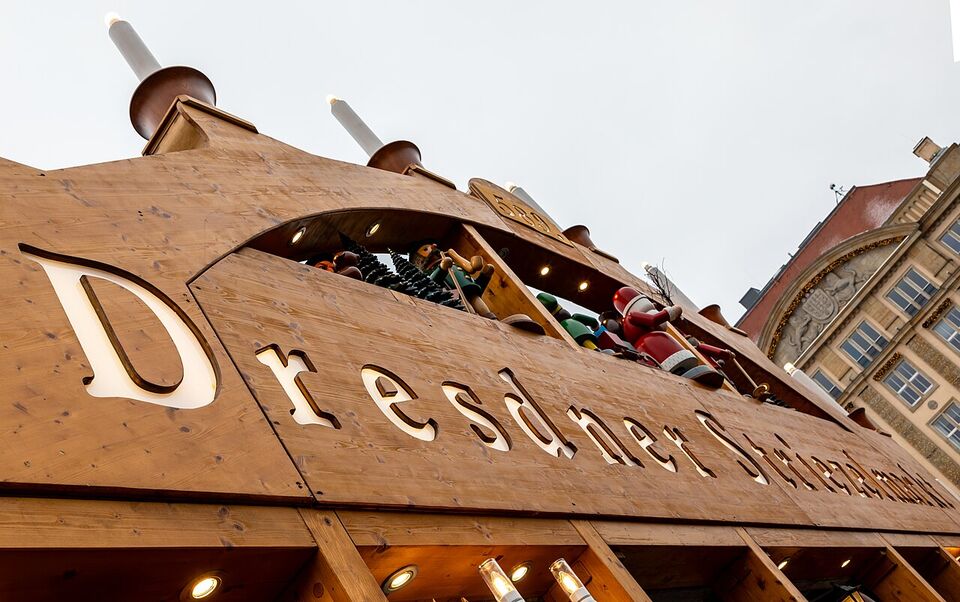
Is December a good month for Germany?
December is the best month for Christmas markets and the hardest to get right on a budget. Every city has a market in the old town, the air smells of cinnamon and woodsmoke, and hotels fill every weekend. It is cold, dark by 4 p.m., and often gray and wet. If you like those conditions, you will have a good trip. If you want castles, hikes or river views, pick another month.
Our advice: base yourself in one or two market cities, go on weekdays, and do not plan sightseeing for December 24 to 26. Book hotels early, because rooms in Nuremberg, Munich, Dresden and Cologne are limited on weekends. For a comparison of months, see when to go to Germany, and for market-by-market details read the Christmas markets guide.
Advent, markets and who closes when
Advent (Adventszeit) is the four-Sunday countdown to Christmas. In 2026 the Sundays fall on November 29, December 6, December 13 and December 20. Families light one more candle on the Advent wreath each Sunday, and the markets are at their busiest on those weekends. St. Nicholas Day, December 6, is a children's custom: kids put out a shoe to find sweets in the morning.
Closing dates differ, so decide where you will be on December 22, 23 and 24 before you book.
| When it ends (2026) | Markets |
|---|---|
| December 22 | Heidelberg, Frankfurt, Berlin-Spandau |
| December 23 | Stuttgart, Hamburg Rathausmarkt, Aachen, Leipzig, Rothenburg, Cologne cathedral and Neumarkt, Munich Weihnachtsdorf at the Residenz |
| December 24 (until 2 p.m.) | Nuremberg Christkindlesmarkt, Munich Marienplatz, Dresden Striezelmarkt (all open 10 a.m. to 2 p.m.) |
| December 26-27 | Berlin Alexanderplatz and Potsdamer Platz (December 26), Schloss Charlottenburg (December 27) |
| After Christmas | Berlin Gendarmenmarkt (December 31), Rotes Rathaus, Breitscheidplatz and Humboldt Forum (January 3), Cologne Altstadt (January 10), Munich Viktualienmarkt and Maibaum markets (January 5-6) |
The Hamburg Winterdom funfair ends on December 6, and the Tollwood winter festival in Munich runs to December 23. Dates come from city pages and, for some, secondary sources, so confirm them before you plan around a specific day. Opening hours for some markets, including Berlin and Cologne, were not listed on the pages we read, and the city sites will have the latest times.
Watch out
Markets are a favorite place for pickpockets, and so are big train stations. Thieves work in teams and use distraction. Keep your wallet and phone in a zipped front pocket. Expect police, barriers and random bag checks at the larger markets, and arrive a few minutes early at the entrances.
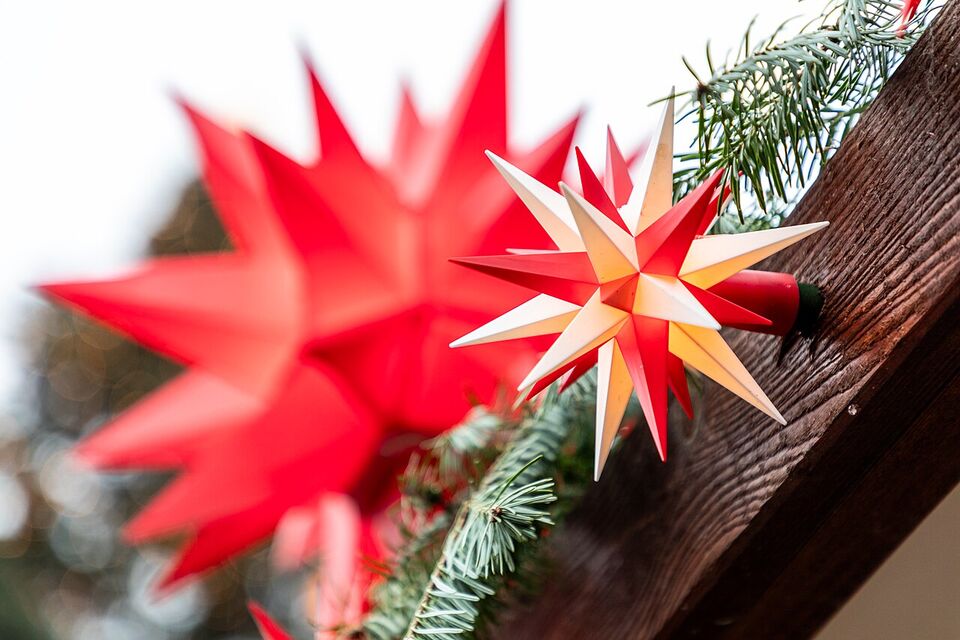
December 24, 25 and 26
The main Christmas celebration in Germany is the evening of December 24 (Heiligabend), with a family dinner and gifts. Christmas Day (December 25) and Boxing Day (zweiter Weihnachtsfeiertag, December 26) are both public holidays in all 16 states. In 2026 they fall on Friday and Saturday, followed by a normal Sunday closure on December 27, so shops are shut for three days in a row.
- Thursday, December 24: Shops close at about 2 p.m. (a common rule, though supermarkets may close earlier). Markets in Nuremberg, Munich and Dresden are open from 10 a.m. to 2 p.m. only. Public transport runs on a reduced holiday schedule, so check times in the local transit app.
- Friday, December 25, and Saturday, December 26: Everything is quiet. Some restaurants and hotel dining rooms open for holiday menus, often with reservations, but many are closed. Museums vary: check each site.
- Sunday, December 27: Regular Sunday closing applies to shops.
Different from home
There is no "day after Christmas sale" shopping rush. The shops are closed for three straight days, and supermarkets are empty on December 23 and 24. Stock up on food, water and cash by the morning of December 24, or buy in a train station shop that is allowed to open.
Sights to know about. These closing days come from the attractions' own pages, and others may also close:
| Place | December 24 | Other closures |
|---|---|---|
| Neuschwanstein and Hohenschwangau | Closed | Also closed December 25 and 31 and January 1. Tours otherwise run daily 10 a.m. to 4 p.m. |
| Reichstag dome, Berlin | Closed all day | Closes at 4 p.m. on December 31 (last entry 2:30 p.m.) |
| Berlin Wall Memorial | Closed | Closed December 25 and 31. Open noon to 6 p.m. on December 26 and January 1 |
| DDR Museum, Berlin | Closes at 4 p.m. | Also closes at 4 p.m. on December 31 |
| Dachau Memorial | Closed | Otherwise open daily 9 a.m. to 5 p.m. |
| Nuremberg Imperial Castle | Closed | Also closed December 25 and 31 |
| Elbphilharmonie Plaza, Hamburg | Closed | Open December 31 from 10 a.m. to 6 p.m. |
| Europa-Park | Closed | Closed December 25. Winter season runs to January 9, 2027 |
| BallinStadt, Hamburg | Closed | Also closed December 31 |
| Deutsches Auswandererhaus, Bremerhaven | Closed | Open until 4 p.m. on December 31 |
Plan December 24 to 26 as slow days: a walk, a church service (the Christmas Eve services in big churches are often crowded and some need tickets), a long lunch and an evening in your hotel. If you have a flight those days, check the airport's holiday schedule.
New Year's Eve (Silvester)
New Year's Eve is called Silvester in Germany. Berlin has said it plans another free party at the Brandenburg Gate with DJs and fireworks, organized by Kulturprojekte Berlin. As of mid-September 2026 the city had not published details. For the 2025/26 edition, the organizers handed out free online tickets for about 20,000 guests, with a DJ party from 10 p.m. and a fireworks show at midnight, so expect something similar but check the city's site in December.
Fireworks are everywhere at midnight. Under federal rules, consumers may buy fireworks on December 29 to 31 only, the stronger class F2 may be set off only on December 31 and January 1, and buyers must be 18 or older for F2. Fireworks are banned year-round near churches, hospitals and nursing homes, and cities add their own bans. For the 2025/26 turn of the year, Munich banned carrying and firing fireworks in its pedestrian zone, including Marienplatz, from 9 p.m. to 2 a.m., and several Berlin districts restricted firecrackers. Orders for 2026/27 are usually announced in December. Do not carry fireworks onto trains or into crowds.
Shops on December 31 (a Thursday) often close by about 2 p.m., and the legal limit differs by state. January 1, 2027 is a Friday and a national holiday, so shops are closed. Hotels in the big cities charge the highest prices of the year for December 31, and many restaurants offer fixed menus that need reservations. The Reichstag dome closes early and Neuschwanstein is closed, as in the table above.
Weather and daylight
December normals for the six biggest cities are below. They are 1991-2020 averages, so a given day may differ widely. Snow in the cities is irregular and does not usually stay on the ground for long, but damp cold is the rule.
| City | Average high | Average low | Rainy days |
|---|---|---|---|
| Berlin | 39°F (4°C) | 30°F (-1°C) | 16 |
| Munich | 41°F (5°C) | 31°F (-1°C) | 17 |
| Hamburg | 41°F (5°C) | 33°F (0°C) | 18 |
| Frankfurt | 42°F (6°C) | 33°F (0°C) | 16 |
| Cologne | 44°F (7°C) | 34°F (1°C) | 19 |
| Dresden | 39°F (4°C) | 31°F (-1°C) | 16 |
The rainy-day counts use different thresholds (0.1 mm for Berlin, Frankfurt and Dresden; 1.0 mm for Munich, Hamburg and Cologne), so compare each city with itself.
Daylight is short. Berlin has roughly 7 hours 40 minutes of daylight on December 21, and about 8 hours on December 1. Munich has about 8 hours 20 minutes on December 21 and 8 hours 35 minutes on December 1. Expect the sun to rise around 8 a.m. and set between about 3:50 and 4:25 p.m. These are our calculated figures, so check a sunrise table for exact times. The upside is that the markets and lights look their best from 4 p.m., so plan indoor sights by day and market visits at dusk.
Germany is on standard time (CET) in winter. The usual time difference applies: 6 hours ahead of US Eastern, 9 ahead of Pacific.
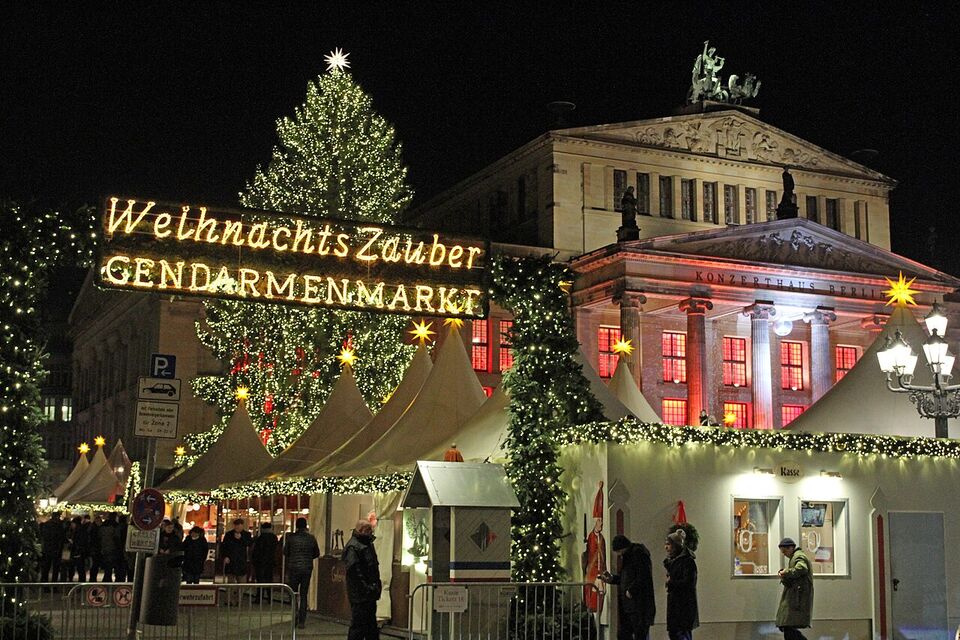
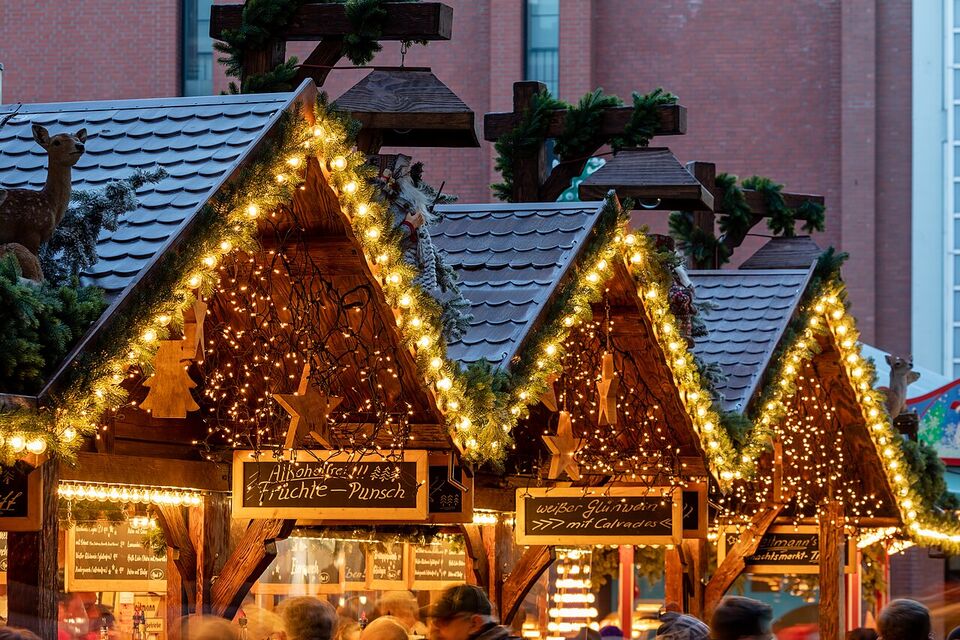
Skiing and the Alps in December
Alpine ski areas open depending on snow, and early-December conditions vary from year to year. For winter 2026/27, the Zugspitze's published prices (valid from November 27, 2026) are €70.50 online (about $79) or €78 at the ticket office (about $87) for a one-day ticket. The Berchtesgaden lift network sells multi-day cards (€102, about $114, for three days). The Zugspitze ski season is expected to run from November 27, 2026 to May 2, 2027, and the nearby Garmisch-Classic area from mid-December to March 29, 2027; the Berchtesgaden lift cards are valid from December 2026 to April 2027. Check each lift's status before you travel, because snow decides the real opening days. See the Bavarian Alps.
The Eagle's Nest (Kehlsteinhaus) near Berchtesgaden is closed after a fire on October 23-24, 2026, with no reopening date. The Obersalzberg Documentation Center is separate and open.
Prices, trains and crowds
Hotel prices are highest on Friday and Saturday nights in market cities, and in the days between Christmas and New Year. Weekdays in early December are much cheaper. Book early for Nuremberg, Munich, Dresden, Cologne and Rothenburg, which has few rooms. Smaller nearby towns often cost less, and trains link them to the market city. For budget planning, see the budget guide.
The Deutsche Bahn timetable changes on December 13, 2026. DB says fares stay stable, and it is adding new Sprinter trains: Berlin to Stuttgart (4 hours 45 minutes) and Hamburg to Munich (5 hours 20 minutes). The Hannover-Berlin high-speed line is closed in stages through 2027, so trips between Cologne or Düsseldorf and Berlin take roughly 5.5 hours. Rail strikes are not announced for the rest of 2026, but check before you travel. Trains fill up on the weekends before Christmas and on December 23 and 26, so reserve a seat (about €5.50 in second class, about $6). See train tickets.
Save money
Stay on a weekday if you can, and book a hotel just outside the center. A day ticket on local transit is cheaper than single rides, such as Munich's €10.10 (about $11) zone M day ticket or Berlin's €11.20 (about $13) 24-hour AB ticket. For Christmas market snacks, a bratwurst or a pretzel makes a cheaper meal than a restaurant.
What to pack
- A warm winter coat, waterproof, with a hood.
- Thermal base layers for long days at markets.
- Hat, scarf, gloves and thick socks.
- Waterproof boots with good grip for cobblestones and ice.
- A small bag that closes, worn in front of you.
- Cash in small bills for market stalls.
Insider tip
Go to the big markets early on a weekday, or after 8 p.m. when families leave. Then walk to the smaller markets in the quieter neighborhoods. Cologne and Munich each have a dozen or more, and some, such as the Pink Christmas market in Munich, have a different atmosphere from the main square.
More on clothing in what to pack for Germany. If you are comparing months, read Germany in November and January.
Add it to a route in the trip builder, or ask us to plan the hotels, trains and guides for you.